Published on December 10, 2025
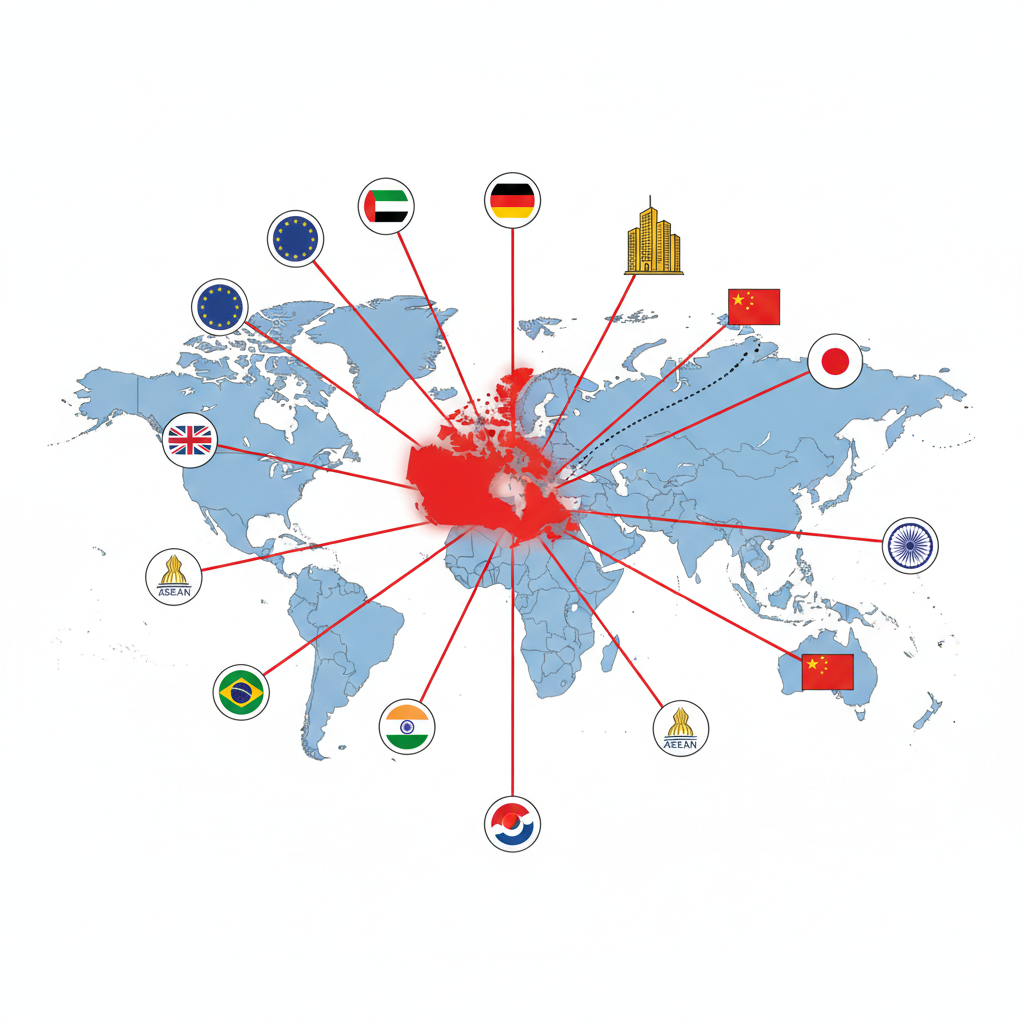
In six months, Mark Carney signed more trade and security deals than most prime ministers manage in a full term. Twelve agreements across four continents, from Berlin to Abu Dhabi to New Delhi. The man racked up more international partnerships than a university student on a gap year.
The obvious question: is this a coherent strategy, or just frantic handshaking?
After spending a few weeks mapping every deal and reading the fine print (what there is of it), my answer is: mostly coherent, with a few question marks, and a lot of promises that haven't been tested yet.
The Full List
Here's every deal, in rough chronological order, with what we know about what's actually in them.
1. EU Strategic Partnership (June 2025) - Comprehensive agreement covering trade, economic security, digital transition, and climate policy. Builds on the existing CETA framework. Opens negotiations on new sectors not covered by CETA [1].
2. G7 Critical Minerals Production Alliance (June 2025) - Created at the Kananaskis G7 summit. Twenty-six new investments and partnerships unlocking $6.4 billion in critical minerals projects across allied countries [2].
3. Ukraine Military and Economic Support (ongoing through 2025) - $2 billion in military assistance plus economic cooperation commitments [3].
4. Germany Critical Minerals and Energy Partnership (August 2025) - Joint declaration covering LNG exports, hydrogen development, rare earth mineral supply chains, defence cooperation, aerospace, and clean energy [4].
5. India Trade Negotiations (launched 2025) - Formal free trade negotiations initiated, building on the Early Progress Trade Agreement framework [5].
6. ASEAN Trade Negotiations (launched 2025) - Exploratory trade talks with the Association of Southeast Asian Nations as a bloc [5].
7. Thailand Bilateral Trade Discussions (2025) - Separate track from ASEAN for bilateral access [5].
8. Philippines Bilateral Trade Discussions (2025) - Similar bilateral approach alongside the broader ASEAN negotiation [5].
9. Mercosur Trade Negotiations (launched 2025) - Talks with the South American trade bloc including Brazil, Argentina, Uruguay, and Paraguay [5].
10. Palestine Recognition and Aid (September 2025) - Formal recognition of Palestinian statehood plus over $400 million in economic support [6].
11. UAE Investment Agreement (November 2025) - $70 billion across energy, AI, logistics, mining. Plus $1 billion critical minerals deal [7].
12. China Tariff-Quota Deal (January 2026) - EV tariffs down, canola tariffs down, with caps and conditions [8].
That's the map. Now let's figure out whether it holds together.
The Strategy Behind the Speed
Every deal serves one of three purposes: replace American trade dependency, secure resource supply chains, or build the middle-power alliance that Carney outlined at Davos.
The European deals (EU, Germany) are about replacing the stable trading relationship Canada had with the US before tariffs made it unstable. Europe is a $17 trillion economy that buys energy, minerals, food, and manufactured goods, exactly what Canada sells [9]. CETA already provides a framework. The new agreements deepen it.
The resource deals (Critical Minerals Alliance, UAE, Germany energy) are about positioning Canada as a key supplier in the global energy transition. The world needs lithium, cobalt, nickel, and rare earths to build batteries, electronics, and renewable energy infrastructure. Canada has them. These deals create the buyers and the investment capital to extract them.
The Asian and South American deals (India, ASEAN, Thailand, Philippines, Mercosur) are about diversifying beyond Europe and America. These are massive consumer markets with growing middle classes. India alone has 1.4 billion people and an economy growing at 6-7% annually [10]. If even a fraction of that growth translates into demand for Canadian agricultural products, minerals, and technology, the trade volumes would be significant.
The China deal stands alone as pure pragmatism: reopening agricultural markets that were closed for political reasons, at the cost of accepting a controlled flow of Chinese manufacturing.
What's Real and What's Aspirational
Not all deals are created equal. Some of these are signed agreements with specific commitments. Others are frameworks for future negotiations. The difference matters.
The EU partnership, Germany deal, and UAE investment are the most concrete. They include specific financial commitments, defined sectors, and implementation timelines. The Critical Minerals Alliance has $6.4 billion in identified projects.
The India, ASEAN, Mercosur, and bilateral Asian negotiations are just that: negotiations. Free trade agreements take years to finalize. The Canada-EU deal (CETA) took seven years from launch to provisional application [11]. India's trade negotiations with other countries have historically been slow and heavily conditioned.
It's entirely possible that the India and Mercosur deals produce agreements within three to five years. It's equally possible they produce years of talks followed by a framework that's more aspiration than enforcement.
The honest count is probably six concrete deals and six active negotiations. Still impressive. Just different from twelve completed agreements.
The Diversification Math
Canada sends roughly 75% of its merchandise exports to the United States. That's about $450 billion in goods annually [12]. Diversifying away from that concentration means building enough alternative trade to absorb shocks if US access gets restricted.
The EU currently buys about 8% of Canadian exports. All of Asia combined buys about 10%. The Middle East, Africa, and South America together account for less than 5% [12].
Even if every deal Carney has signed delivers on its full potential, it would take years to shift that balance meaningfully. You don't redirect $450 billion in trade flows with twelve deals and six months of negotiations. You redirect them with decades of sustained effort, infrastructure investment, and supply chain development.
What the deals do provide is a starting position. Five years ago, Canada's trade diversification strategy was mostly theoretical. Now it has signed frameworks, identified projects, and active negotiations across multiple regions. The starting gun has been fired. The race is long.
The Risks
Speed creates its own problems.
Negotiating multiple trade deals simultaneously stretches Canada's diplomatic and trade negotiation capacity. Global Affairs Canada has talented trade negotiators, but there's a limited pool of them. Running twelve negotiations at once means some get less senior attention than they deserve.
Each deal also creates potential conflicts with other deals. The China EV agreement annoyed the US. European defence procurement might annoy American contractors. Indian trade access might conflict with Canadian agricultural protections that domestic farmers rely on.
Managing a web of international relationships where each partner has different expectations and different values is enormously complex. It requires coordination across government departments, sustained diplomatic engagement, and the political willingness to make trade-offs that will annoy someone in every deal.
The historical parallel: Pierre Trudeau's "Third Option" strategy in the 1970s attempted something similar: diversifying Canadian trade away from American dependence toward Europe and Asia [13]. It produced some agreements but ultimately didn't change the fundamental structure of Canadian trade. The US remained dominant because geography, infrastructure, and economic integration made American trade easier and cheaper than the alternatives.
Carney's version benefits from better conditions: US trade is actively deteriorating, global supply chains are restructuring, and Canada's resource endowment aligns with what the world needs for the energy transition. But the Third Option comparison is a useful caution against assuming that trade diversification is just a matter of political will.
The Bottom Line
Twelve deals in six months is genuine accomplishment, regardless of how many are fully finalized versus in-progress. The direction is clear: Canada is building a network of economic relationships that reduces dependence on any single partner.
Whether that network delivers meaningful economic benefit depends on execution over years, not months. Trade infrastructure, supply chains, and commercial relationships take time to develop. The deals signed in 2025 are the seeds. The harvest comes later.
For Canadian businesses, the message is that new markets are opening. Agricultural exporters should be watching India and China. Mineral producers should be watching Europe and the UAE. Technology companies should be watching the EU digital partnership.
For Canadian workers, the short-term impact is modest. The long-term impact could be significant, particularly in resource extraction, agricultural processing, and defence manufacturing, if the deals translate into sustained demand.
For Canadian taxpayers, the cost of all this deal-making is real: diplomatic resources, trade missions, and implementation spending. Whether it's money well spent depends on whether the world still looks like this in five years, or whether the geopolitical landscape shifts again and the entire strategy needs rewriting.
If there's one lesson from Canadian trade history, it's that the world changes faster than trade agreements do. Carney is betting on a particular vision of the future. Twelve deals deep, it's a bet worth watching.
References
[1] Prime Minister of Canada. "Canada-EU Strategic Partnership." June 23, 2025.
[2] Prime Minister of Canada. "G7 Critical Minerals Production Alliance." June 2025.
[3] Prime Minister of Canada. "Canada's Support for Ukraine." 2025.
[4] Prime Minister of Canada. "Canada-Germany Partnership on Critical Minerals and Energy." August 26, 2025.
[5] Global Affairs Canada. "Trade Negotiations: Status Update." 2025-2026.
[6] Prime Minister of Canada. "Canada's Recognition of the State of Palestine." September 21, 2025.
[7] Prime Minister of Canada. "New Agreements with United Arab Emirates." November 21, 2025.
[8] CBC News. "Canada-China EV and Agricultural Tariff Deal." January 16, 2026.
[9] European Commission. "EU-Canada Trade Relations." 2025.
[10] IMF. "India: Staff Report for the 2025 Article IV Consultation." 2025.
[11] European Commission. "CETA: Timeline and Implementation." 2017.
[12] Statistics Canada. "Canadian International Merchandise Trade." Table 12-10-0011-01. 2025.
[13] Mitchell Sharp. "Canada-US Relations: Options for the Future." 1972.