Published on November 10, 2025
There's something genuinely weird about what happened in April 2025.
Canada, a country where people were furious about grocery prices, housing costs, and stagnant wages, elected a man whose resume includes Goldman Sachs, the Governor of the Bank of Canada, the Governor of the Bank of England, and UN Special Envoy on Climate Finance. A man who has spent more time in Davos than most Canadians have spent at their cottage.
And they didn't just elect him. They elected him enthusiastically. 169 seats, 44% of the popular vote, the strongest Liberal showing in years [1]. His opponent, Pierre Poilievre, a career politician who spent four years positioning himself as the voice of working-class frustration, lost his own seat in Ottawa [2].
A Bay Street banker beat a populist by being more popular. That's worth understanding, because it says something about what Canadians actually want from their leaders when the stakes feel high enough.
How Trump Elected Carney
The honest explanation for the Carney victory starts in Washington, not Ottawa.
Donald Trump's tariff threats, annexation rhetoric, and "51st state" comments did more for Liberal Party fundraising than any campaign strategy could have achieved [3]. When the President of the United States publicly discusses absorbing your country, the election stops being about domestic policy and becomes about national survival.
Carney benefited from this dynamic in two ways. First, his international credentials suddenly mattered more than his domestic policy platform. A man who has negotiated with global leaders, managed the British economy through Brexit, and steered Canada through 2008 looked like exactly the person you'd want representing the country against an aggressive foreign leader.
Second, the external threat united a fractured electorate. Progressives who wanted climate action and conservatives who wanted fiscal discipline both agreed on one thing: Canada needed a competent leader who could handle Trump. Carney, with his calm central banker demeanour and his ability to speak economics fluently in three languages, fit the bill.
The irony: Trump's aggression toward Canada was probably intended to weaken the Canadian government. Instead, it strengthened it by giving Canadians a common adversary to rally against.
The Goldman Sachs Problem That Wasn't
In normal times, a Goldman Sachs background is political poison. The bank is practically a cartoon villain in populist rhetoric: too much money, too little accountability, too many former employees in government positions around the world.
Carney worked at Goldman for thirteen years before entering public service [4]. In any other election, his opponents would have hammered that connection relentlessly. Poilievre tried. It didn't stick.
Why? Because the same qualities that make Goldman Sachs unpopular in abstract, elite connections, financial sophistication, global networks, make its alumni attractive when the country feels threatened. You don't want your heart surgeon to be relatable. You want them to be the best in the room. When Trump was threatening the Canadian economy, voters chose competence over relatability.
This represents a significant shift in Canadian political psychology. For years, the trend in democracies worldwide has been toward "authentic" leaders, people who seem like they could be your neighbour, who speak plainly, who emphasize common roots. Carney is the opposite of that. He's an expert. He's elite. He's about as "regular guy" as a Swiss watch.
And Canadians chose him anyway, because the situation felt serious enough to warrant an expert.
What Poilievre Got Wrong
Pierre Poilievre ran a disciplined campaign built on cost-of-living anger. "Axe the tax" was effective messaging. His YouTube presence reached millions. His rallies drew crowds that Liberal events couldn't match [5].
By conventional political wisdom, Poilievre should have won. Inflation was high. Housing was unaffordable. The incumbent government was deeply unpopular. Every historical indicator pointed to a change election.
But Poilievre made a strategic bet that the election would be fought on domestic economic grievance. Trump changed the battlefield. When the conversation shifted from grocery prices to national sovereignty, Poilievre's skill set, sharp-elbowed domestic politics, parliamentary tactics, retail-level populism, became less relevant than Carney's skill set: international negotiation, macroeconomic management, and crisis leadership.
Losing his own riding was the most dramatic expression of this miscalculation. Ottawa West-Nepean, a suburban riding with a large public service population, chose a different candidate over the Conservative leader who had spent four years talking about cutting government [6]. The public servants who would have been affected by his spending cuts lived in his riding and voted accordingly.
The NDP Collapse
The other story from April 2025 was the NDP's reduction to 7 seats, losing official party status for the first time since 1993 [1].
Under Jagmeet Singh, the NDP had influenced the Liberal agenda through a supply and confidence agreement, securing pharmacare, dental care, and anti-scab legislation. But those achievements were credited to the Liberals who implemented them, not the NDP who demanded them.
When the election became about national security and economic competence against Trump, the NDP's social democratic message got squeezed. Progressive voters moved to the Liberals to consolidate behind Carney. Working-class voters in resource communities moved to the Conservatives.
The result was a parliament without a meaningful progressive caucus. No NDP pressure means no push for pharmacare expansion, no push for stronger labour protections, and no push for the social spending priorities that the NDP traditionally champions.
For Carney, this is both a freedom and a risk. Freedom to govern without progressive conditions attached. Risk that the progressive voters who supported him expect progressive outcomes and will punish him if they don't materialize.
The Central Banker in the Prime Minister's Office
Carney governs like a central banker. This isn't a criticism or a compliment. It's a description.
Central bankers make decisions based on data, models, and long-term equilibrium thinking. They communicate in carefully calibrated language designed to manage expectations. They avoid emotional appeals and dramatic gestures. They prioritize stability over transformation.
Watch Carney in Question Period and the style is obvious. He answers with numbers. He reframes emotional questions into analytical frameworks. He deflects partisan attacks by discussing policy mechanisms rather than engaging with the underlying anger.
This works brilliantly in certain contexts: international negotiations, crisis management, and complex policy design. It works poorly in others: connecting with voters who are angry about real problems, communicating empathy for lived experiences, and inspiring the kind of emotional loyalty that sustains political support over time.
Every prime minister faces a moment where the analytical approach isn't enough, where people need to feel heard, not briefed. Carney hasn't faced that moment yet. When he does, the central banker persona will be tested in ways that monetary policy never required.
The Bottom Line
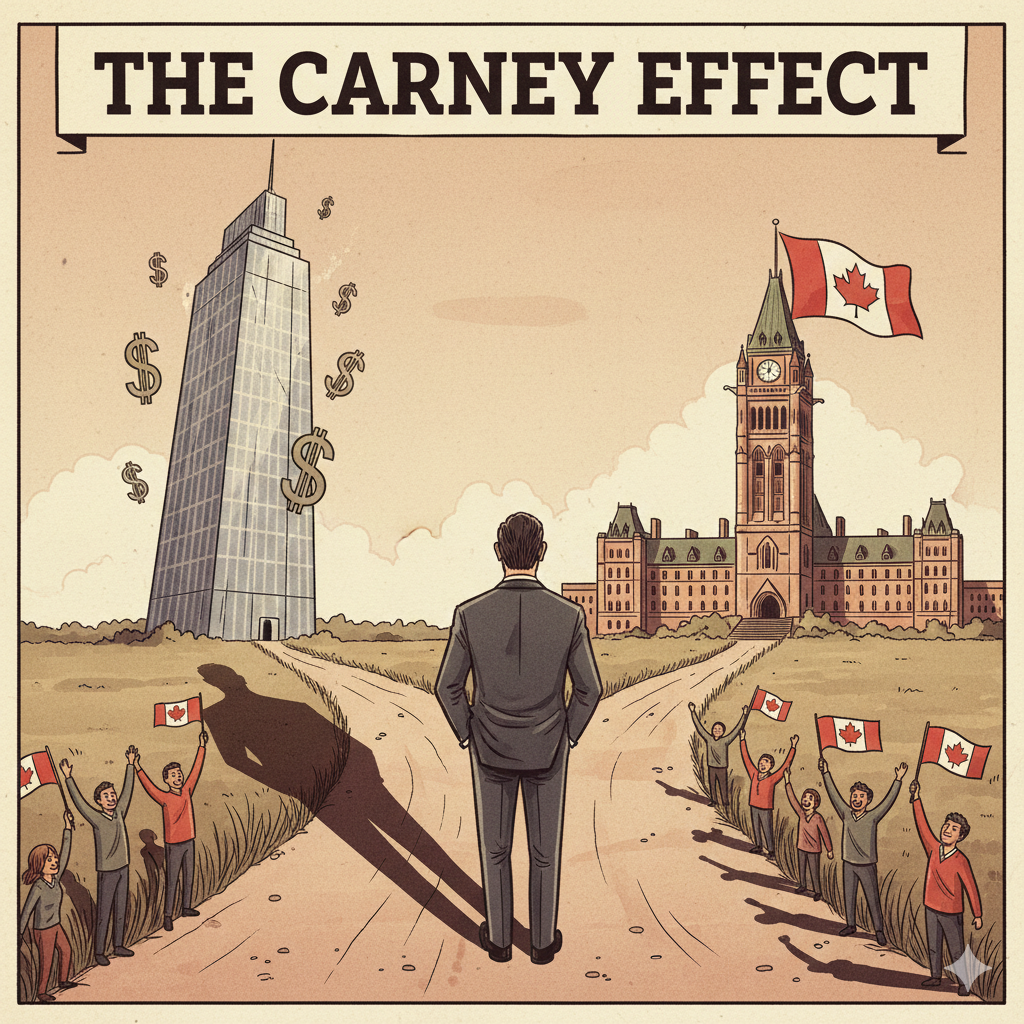
The Carney Effect is the product of unusual circumstances: an external threat that elevated competence over charisma, a populist opponent caught on the wrong battlefield, and a Canadian electorate that chose expertise over anger when the stakes felt existential.
Whether that effect sustains beyond the crisis that created it is the central question of Canadian politics for the next three years. Trump's tariffs and annexation talk won't be the dominant issue forever. Eventually, the election returns to grocery prices, wait times, and mortgage payments. When it does, Carney will need more than a central banker's demeanour and an impressive resume.
He'll need to show that the Goldman Sachs guy with the Davos speeches and the European travel schedule actually made life better for the family in Brampton trying to make rent.
That's a different kind of test. And it's coming.
References
[1] Elections Canada. "43rd General Election Official Results." April 28, 2025.
[2] CBC News. "Poilievre loses Ottawa seat in historic upset." April 28, 2025.
[3] NPR. "Canada election: How Trump's rhetoric shaped Canada's vote." April 29, 2025.
[4] Carney, Mark. "Value(s): Building a Better World for All." Signal/McClelland & Stewart. 2021.
[5] Globe and Mail. "Inside the Poilievre campaign's digital strategy." 2025.
[6] CBC News. "Ottawa West-Nepean riding results." April 28, 2025.