Published on May 1, 2026
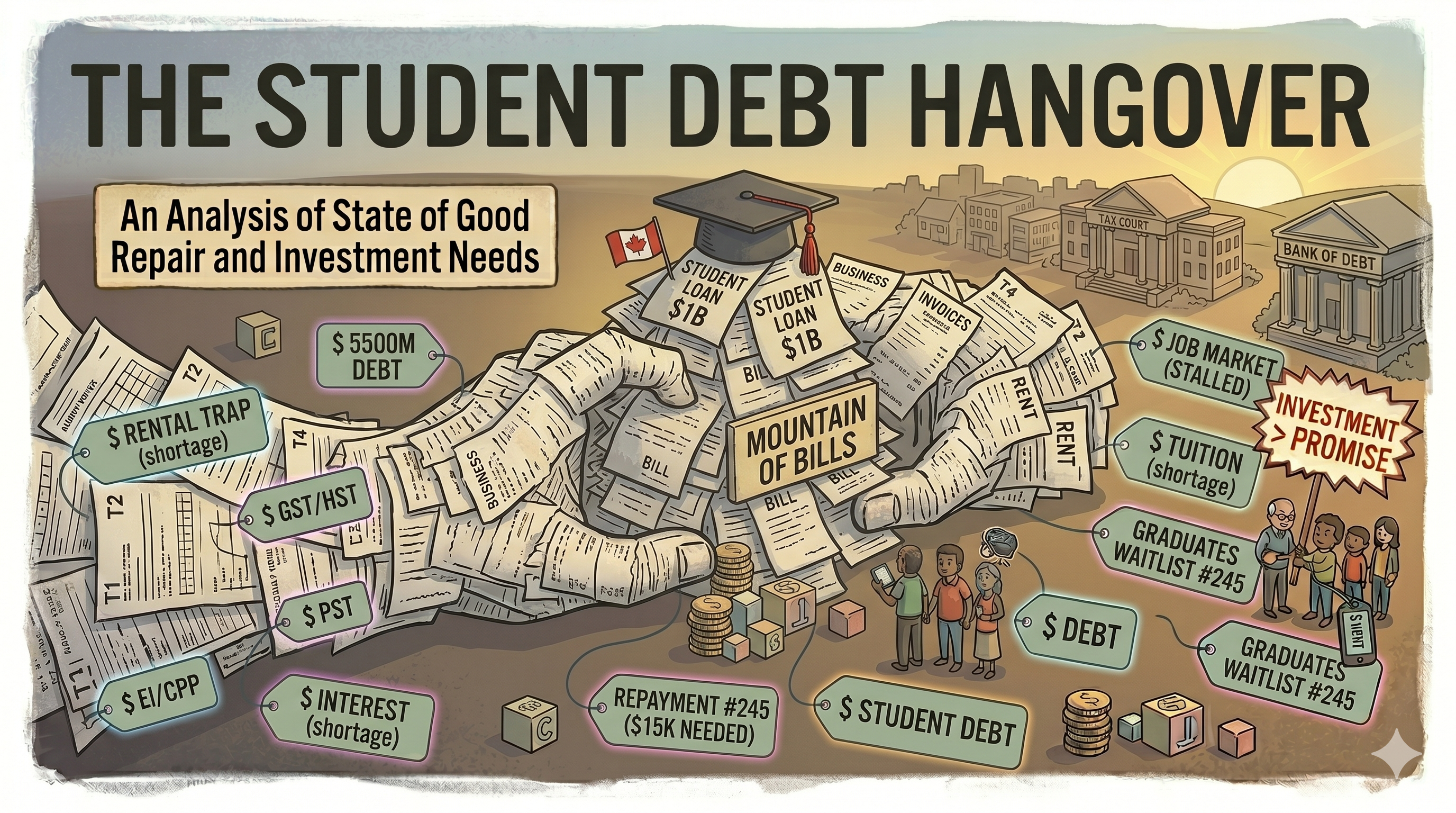
Every September, hundreds of thousands of eighteen-year-olds march onto Canadian campuses carrying laptops, laundry bags, and the unshakeable belief that the next four years will be the best investment of their lives. By the time they walk across the stage four (or five, or six) years later, the average graduate is carrying something else entirely: roughly $28,000 in student debt [1]. That's a mid-range sedan's worth of money spent on something you can't drive to work — assuming you can find work in your field.
So the question rattling around every graduating class photo is simple: was it worth it? The answer, like most things in Canadian economics, is "it depends on where you live, what you studied, and whether you define 'worth it' the same way your parents did."
The Tuition Escalator
If you graduated in the early 2000s, you might remember tuition feeling expensive at the time. You were adorable. Average undergraduate tuition in Canada sat around $3,400 in the 2000-2001 academic year. By 2024-2025, that number had climbed to approximately $7,076 nationally [2]. That's a 108% increase in a period when overall inflation rose about 65%. Tuition didn't just keep pace with the cost of living — it lapped it.
But averages hide a lot of provincial drama. Ontario leads the pack with average undergraduate tuition around $8,190 per year, because Ontario likes being first at expensive things. Quebec, meanwhile, sits closer to $3,500 for in-province students, thanks to a decades-old political consensus that affordable education is worth subsidizing. Newfoundland and Labrador has historically kept tuition frozen at some of the lowest levels in the country. British Columbia and Alberta land somewhere in between, fluctuating with each government's enthusiasm for post-secondary funding.
Professional programs are where things get truly eye-watering. Dentistry averages above $25,000 per year nationally. Law school runs $15,000 to $20,000 depending on the province. Medical school tuition varies wildly — around $7,000 in Quebec, over $20,000 in Ontario. You can spend more on a single year of dental school than many Canadians earn in six months.
OSAP and the Repayment Maze
If you've ever tried to understand the Canada Student Loans Program, you know it reads like it was designed by someone who thinks tax forms are too straightforward. The federal government covers 60% of assessed need through the Canada Student Financial Assistance program, and provinces top up the rest through their own programs — OSAP in Ontario, StudentsNS in Nova Scotia, and so on.
The mechanics work roughly like this: you apply, a bureaucratic algorithm decides how much your family can contribute (often disagreeing wildly with what your family thinks they can contribute), and you receive a mix of grants and loans. Since 2024, the federal interest rate on the Canada Student Loan portion sits at prime, after the government eliminated the interest premium. Provincial portions vary — Ontario charges prime on its share, while some provinces still tack on extra.
The repayment assistance plan kicks in six months after graduation. If you earn under roughly $40,000 per year, you can apply for the Repayment Assistance Program, which can reduce or eliminate your monthly payments. The catch? Interest keeps accumulating on the provincial portion in some jurisdictions, which means the debt quietly grows while you're struggling to find full-time employment in your field.
Statistics Canada data shows that the median time to full repayment for bachelor's degree holders is approximately eight to ten years after graduation [3]. That's a decade of monthly payments competing with rent, groceries, and the vague dream of someday owning property. And those are the graduates who manage to stay on schedule — borrowers who hit unemployment, underemployment, or the classic "working three contract positions that each offer 15 hours a week" scenario can find themselves carrying student debt well into their thirties.
The Earnings Premium: Does the Paper Pay?
The traditional argument for university has always been the earnings premium — the gap between what degree-holders earn and what everyone else takes home. And that premium is real. According to the Conference Board of Canada and Statistics Canada census data, Canadians with a bachelor's degree earn roughly 40% more over their careers than those with only a high school diploma [4]. Over a 35-year career, that gap adds up to several hundred thousand dollars in cumulative earnings.
But zoom in a little, and the picture gets complicated. College diploma holders — the two-year and three-year program graduates — earn about 20-25% more than high school-only workers. Skilled tradespeople with Red Seal certifications often match or exceed bachelor's degree earnings, particularly in their peak earning years, and they started earning sooner.
Think about that math for a second. A plumber who starts an apprenticeship at 18 is earning while learning, often clearing $50,000-$60,000 annually by their early twenties. A university graduate who finishes at 22 spent four years paying tuition and not earning a full-time salary. The opportunity cost — four years of lost wages plus $28,000 in debt — means the university graduate needs to out-earn the trades worker by a significant margin just to break even. In many cases, they do. In some cases, they never catch up.
The Great Trades Gap
And now we arrive at one of the strangest mismatches in the Canadian economy. Employment and Social Development Canada projects that approximately 700,000 skilled trades workers will retire by 2028 [5]. Seven hundred thousand. That's roughly the entire population of Mississauga putting down their tools and heading for the cottage.
Apprenticeship registrations have not kept pace. Completion rates for apprenticeship programs sit around 50-60% nationally, meaning nearly half of everyone who starts an apprenticeship doesn't finish [6]. Meanwhile, university enrollment keeps climbing, driven partly by cultural expectations and partly by the simple fact that every career guidance counsellor in the country has been trained to ask "so, which university are you applying to?" as if it were the only question worth asking.
The result is a country that produces more marketing graduates than it needs and fewer electricians than it can function without. Walk through any suburban development in the GTA and count the "Now Hiring" signs at construction sites. Then walk through any downtown office tower and count the baristas with bachelor's degrees. The mismatch is not subtle. The wage implications are predictable: skilled trades wages have been climbing steadily, with journeyperson electricians, plumbers, and welders routinely earning $80,000 to $100,000 or more in major markets. That Red Seal certification is starting to look less like a consolation prize and more like a golden ticket.
Which Degrees Actually Pay Off?
Not all degrees are created equal, and pretending otherwise does students a disservice. Statistics Canada's National Graduates Survey and census earnings data paint a clear picture of which fields generate returns and which generate regrets [7].
At the top of the earnings curve: engineering graduates see median earnings above $75,000 within five years of graduation. Nursing and health sciences graduates are practically guaranteed employment, with starting salaries around $65,000-$75,000 and chronic labour shortages ensuring job security. Computer science remains strong, though the market has cooled slightly from its pandemic peak. Business (specifically accounting and finance specializations) holds steady with reliable employment pathways.
In the middle: education degrees lead to stable but modestly-paid careers, with teacher salaries ranging from $45,000 starting to $100,000+ at the top of the grid. Sciences without graduate school often lead to a awkward limbo — too qualified for some jobs, under-qualified for others.
At the lower end of the earnings spectrum: humanities and social sciences graduates face median earnings in the $40,000-$50,000 range five years out. These degrees develop genuine skills — critical thinking, communication, research — but the job market doesn't price those skills as generously as it prices the ability to design a bridge or insert an IV.
None of this means an English degree is worthless. It means an English degree requires a clearer plan for how you'll convert it into earnings. Stack it with a communications certificate, a co-op placement, or a minor in data analytics, and suddenly that humanities foundation starts looking strategic rather than sentimental. "I'll figure it out" is an expensive strategy when you're carrying $28,000 in debt. "I'll figure it out while building transferable skills and making industry contacts" is a much better one.
The International Student Revenue Machine
Canadian universities discovered something interesting over the past fifteen years: international students pay dramatically higher tuition. While a domestic undergraduate might pay $7,000 a year, an international student at the same institution pays $38,000 to $45,000 for the same seat in the same lecture hall [8].
This created a powerful financial incentive. International student enrollment in Canada surged from around 240,000 in 2010 to over 800,000 by 2023. Universities and colleges — especially colleges — expanded programs, built new residences, and hired recruitment agents across India, China, Nigeria, and the Philippines. International tuition revenue became a structural pillar of institutional budgets, in some cases accounting for 40-50% of total tuition income.
The federal government has since imposed caps on international student permits, citing housing pressures and program quality concerns. But the underlying dynamic remains: Canadian post-secondary institutions have become partially dependent on international fees to subsidize domestic students and fund operations. When you pay $7,000 in tuition and your university's operating costs per student are closer to $20,000, someone is making up the difference — and increasingly, that someone sits in a lecture hall with a study permit.
Whether this model is sustainable, ethical, or even good for education quality is a question Canadian universities have been remarkably reluctant to answer honestly.
The Opportunity Cost Calculator
The real ROI calculation isn't just tuition minus future earnings. It's more brutal than that. Consider two eighteen-year-olds graduating high school in Ontario today.
Path A: University. Four years of tuition averaging $8,190 per year ($32,760 total). Four years of living expenses, even if living at home, conservatively $8,000-$10,000 per year. Four years of foregone full-time earnings — if they'd been working at even $40,000 per year, that's $160,000 in wages they didn't earn. Total investment: roughly $200,000 in hard costs and opportunity costs combined.
Path B: Skilled trade. Start an apprenticeship at 18, earning while training. Four years later, they've accumulated perhaps $140,000-$160,000 in cumulative earnings and hold a journeyperson ticket with zero student debt.
The gap between these two paths at age 22 is enormous — potentially $300,000 or more when you combine what one spent with what the other earned. The university graduate needs the earnings premium to close that gap over the subsequent decades. For engineers, nurses, and accountants, that usually happens by their early thirties. For graduates in lower-earning fields, the crossover point might not arrive until their forties — if it arrives at all.
This doesn't mean everyone should skip university and become a plumber. The economy needs researchers, teachers, social workers, and policy analysts. But it does mean the decision deserves the same financial scrutiny you'd apply to any other $200,000 investment. You wouldn't buy a house without running the numbers. Why would you buy a degree without doing the same?
The Bottom Line
The student debt hangover is real, and it hits hardest when graduates discover that their degree is necessary but not sufficient — a minimum qualification rather than a golden ticket. The earnings premium still exists, but it varies enormously by field, by province, and by individual circumstances.
If you're seventeen and staring down the application deadline, you owe yourself an honest conversation about what you're buying and what it will cost you — not just in tuition, but in years and options. If engineering or nursing excites you, the ROI is strong and the math works in your favour. If you're drawn to the humanities, go in with a plan and understand the financial trade-offs. And if you're good with your hands and nobody has mentioned the trades to you, maybe that's the conversation worth having over your next Tim Hortons coffee.
Canada is about to lose 700,000 skilled trades workers to retirement. Somebody has to replace them. It might as well be somebody who graduates debt-free with a Red Seal certification and a career that can't be outsourced to a chatbot.
References
[1] Statistics Canada, "National Graduates Survey," 2023. Average student debt at graduation for bachelor's degree holders.
[2] Statistics Canada, "Tuition fees for degree programs," The Daily, September 2024. Table 37-10-0003-01.
[3] Statistics Canada, National Graduates Survey, various years. Longitudinal data on student loan repayment timelines.
[4] Conference Board of Canada, "Education and Skills: The Return on Investment in Post-Secondary Education." Statistics Canada Census data on earnings by education level.
[5] Employment and Social Development Canada (ESDC), "Canadian Occupational Projection System (COPS)," projected skilled trades retirements through 2028.
[6] Statistics Canada, "Registered Apprenticeship Information System," completion and certification rates for apprenticeship programs.
[7] Statistics Canada, National Graduates Survey and Census 2021. Median earnings by field of study, various timeframes post-graduation.
[8] Statistics Canada, "International students in Canadian post-secondary institutions," and IRCC study permit data. Tuition differential data from institutional reporting.