Published on May 20, 2026
You've probably heard it a thousand times by now. "If you can't afford to buy, just rent!" People say it like they're offering profound wisdom, like they've cracked some code the rest of us missed. As if renting in Canada in 2026 is some kind of affordable, stress-free alternative to homeownership rather than its own special flavour of financial pain.
The Canadian rental market has become a pressure cooker. Ownership is out of reach for millions. Renting is eating up half of people's paycheques. And somewhere between those two realities, an entire generation is watching their financial futures evaporate — month by month, rent cheque by rent cheque.
So what's actually going on? And more importantly, is there a way out?
The Numbers That Keep You Up at Night
If you're renting in a major Canadian city right now, you already know this in your gut. But the data from CMHC's Rental Market Report and Statistics Canada confirms what your bank account has been screaming at you [1][2].
Average asking rents for a two-bedroom apartment in 2025-2026:
- Vancouver: $2,800+ per month
- Toronto: $2,650+ per month
- Calgary: $1,850+ per month
- Ottawa: $1,900+ per month
- Montreal: $1,750+ per month
- Halifax: $1,950+ per month
And these are averages. If you want something near transit, near your job, near a school — add a few hundred more. In downtown Toronto or Vancouver, a one-bedroom can easily clear $2,400.
Meanwhile, the median individual income in Canada sits around $44,000 before taxes [2]. Run that math quickly. A $2,650 monthly rent in Toronto works out to $31,800 per year — roughly 72% of pre-tax median income. Even in supposedly "affordable" Montreal, you're looking at about 48%.
The old rule of thumb says housing should cost no more than 30% of your gross income. According to the Parliamentary Budget Officer's housing affordability analysis, approximately 47% of Canadian renters now exceed that threshold [3]. In Toronto and Vancouver, it's closer to 60%.
That 30% rule isn't some arbitrary guideline. It exists because once you cross it, everything else in your budget starts to collapse — groceries, savings, debt repayment, the occasional dinner out that keeps you sane. Cross 50%, and you're essentially living paycheque to paycheque regardless of how much you earn.
Who Rents in Canada — and Why It Matters
There's a persistent myth that renting is a temporary stop on the way to ownership, something you do in your twenties before "growing up" and buying a house. That story doesn't match reality anymore.
About one-third of Canadian households rent, according to the 2021 Census [2]. That's roughly 5 million households. And the demographics tell a pointed story:
- Young adults (25-34): Over 50% rent, many involuntarily — they'd buy if they could
- Recent immigrants: Roughly 70% rent in their first five years in Canada
- Single-parent families: Disproportionately represented in the rental market
- Seniors on fixed incomes: A growing share, increasingly vulnerable to rent increases
- Essential workers: Nurses, teachers, paramedics — people cities literally cannot function without
This isn't a niche issue affecting a small slice of the population. This is the housing reality for millions of Canadians, including the people who keep hospitals running and classrooms open. When a nurse in Toronto is spending 55% of their income on a basement apartment an hour from the hospital, something has gone structurally wrong.
The Financialization Problem
Ever wonder who your landlord actually is? Increasingly, it's not a person — it's a corporation.
Real Estate Investment Trusts (REITs), pension funds, and institutional investors have been steadily acquiring Canadian rental stock for over two decades. A 2023 report from the Office of the Federal Housing Advocate found that financialized landlords — REITs, asset management firms, and private equity — own a significant and growing share of purpose-built rental housing in Canada, particularly in Ontario and Atlantic Canada [4].
Why does this matter? Because the business model is fundamentally different from a small landlord renting out a basement suite. REITs have a fiduciary duty to maximize returns for shareholders. That means:
- Aggressive rent increases whenever legally possible
- "Renovictions" — evicting tenants under the guise of renovations, then re-listing at market rates
- Minimal maintenance on units where rent-controlled tenants live, incentivizing them to leave
- Lobbying against rent control and tenant protections
When housing becomes a financial asset optimized for quarterly returns, the person living in it becomes an obstacle to profit rather than the entire point of the building's existence.
The Rent Control Patchwork
Canada doesn't have a national approach to rent control. Instead, you get a provincial patchwork that ranges from "somewhat protective" to "good luck out there."
Ontario runs a dual system that perfectly illustrates the problem. Units first occupied before November 15, 2018 have rent increases capped at a provincial guideline — 2.5% for 2025. But units first occupied after that date? No cap at all. Your landlord can raise rent by whatever amount they want, once per year, with 90 days' notice. Doug Ford's government removed controls on new builds to "encourage construction." The construction boom hasn't exactly materialized, but the uncapped rent increases certainly have.
British Columbia ties annual allowable increases to inflation, currently around 3-3.5%. It applies to most existing tenancies. It's more consistent than Ontario's split system, but it still doesn't help you when you're looking at the asking rent on a new unit.
Quebec has a system where landlords must justify increases and tenants can challenge them at the Tribunal administratif du logement. In practice, many tenants — especially newcomers who don't know their rights — accept whatever increase the landlord proposes.
Alberta has no rent control whatsoever. None. A landlord can raise your rent by any amount with proper notice. In a market where Calgary rents have jumped over 30% in three years, that's a recipe for displacement.
The fundamental tension in rent control economics is real: strict controls can discourage new construction and maintenance. But the absence of any controls leaves tenants completely exposed to market forces in a market with chronically low supply. Neither extreme works. The question is finding the balance point, and most provinces haven't found it.
The Construction Problem Nobody Wants to Talk About
Canada needs more rental housing. Everyone agrees on that. But the market keeps building the wrong thing.
Purpose-built rental buildings — apartments constructed specifically as long-term rentals — made up the backbone of Canadian rental housing stock built in the 1960s and 1970s. Those buildings are now 50-60 years old, and we haven't replaced them at anywhere near the necessary rate.
Why? Because the math doesn't work for developers. Building a condo tower, selling units individually, and walking away with your profit in 2-3 years is far more attractive than building a rental tower and waiting 20-30 years to recoup your investment through monthly rents. CMHC data shows that condo completions have outpaced purpose-built rental completions by roughly 3-to-1 in major markets over the past decade [1].
The federal government has tried to change this equation — the Apartment Construction Loan Program, the Housing Accelerator Fund, various GST rebates. Provincial governments have offered incentives too. But the gap between what it costs to build rental housing and what tenants can actually afford to pay remains wide. You can't subsidize your way out of a problem this large without fundamentally rethinking how rental housing gets financed and built.
Meanwhile, vacancy rates tell the supply story in brutal shorthand. CMHC's 2024 Rental Market Report put the national purpose-built rental vacancy rate at about 1.9% — marginally up from historic lows, but still well below the 3-5% range that economists consider balanced [1]. In Toronto, it hovered around 2.1%. In Vancouver, about 1.6%. When vacancy is that tight, landlords have all the pricing power and tenants have almost none.
Renovictions, Demovictions, and the Loopholes That Eat Tenants Alive
Even where rent control exists on paper, the enforcement mechanisms are riddled with loopholes that sophisticated landlords exploit routinely.
Renovictions happen when a landlord evicts a tenant for "major renovations," completes cosmetic upgrades, and re-lists the unit at double the previous rent. Ontario and BC have both tightened rules around this, but enforcement remains inconsistent. The burden often falls on the tenant to challenge the eviction at a tribunal, a process that can take months — months during which the tenant needs to find somewhere else to live.
Demovictions work similarly but with demolition. Tear down an older building with affordable rents, replace it with a new building exempt from rent control (in Ontario) or listed at current market rates. The existing tenants theoretically have a right to return at a comparable rent, but the gap between theory and practice is wide enough to drive a moving truck through.
These aren't edge cases. Housing advocacy organizations across Canada document thousands of these situations every year. For the tenant on the receiving end, it doesn't matter that the law technically protects you if the tribunal hearing is eight months away and you need somewhere to sleep next Tuesday.
What Other Countries Do Differently
Canada isn't the only country grappling with rental affordability, but some places have found approaches worth studying.
Vienna, Austria is the gold standard that housing wonks love to cite — and for good reason. Roughly 60% of Vienna's residents live in subsidized or publicly owned housing. The city has been building and maintaining public housing for over a century. The result: housing costs in Vienna average about 20-25% of household income, in a city with a comparable quality of life to Toronto or Vancouver. The catch? Vienna committed to this model decades ago and sustained it through every political cycle. It's infrastructure, not a program.
Singapore takes a different approach — about 80% of residents live in public housing built by the Housing Development Board. Units are sold on 99-year leases at subsidized prices. It's homeownership, but with the government as master developer and price regulator.
Finland has nearly eliminated homelessness through a Housing First approach combined with significant public investment in affordable housing stock.
The common thread? Government involvement not as a regulator standing at the edges of a private market, but as a direct participant — building, owning, and operating housing at scale. Canada has largely abandoned that approach since the federal government pulled out of social housing construction in the 1990s. The question is whether there's political will to get back in.
The Bottom Line
The advice to "just rent" assumes a functioning rental market where supply roughly meets demand, where tenants have reasonable choices, and where rents bear some relationship to what people actually earn. That market doesn't exist in most of urban Canada right now.
What exists instead is a system where 47% of renters are financially stretched beyond the recommended threshold. Where institutional investors optimize rental buildings for shareholder returns. Where the patchwork of provincial regulations creates protection for some tenants and none for others. Where the vacancy rates are so low that landlords can charge nearly anything and someone desperate enough will pay it.
None of this is inevitable. Other countries have demonstrated that rental markets can function without consuming half of people's incomes. But fixing Canada's rental crisis requires more than marginal policy tweaks — it requires building rental housing at a pace and scale this country hasn't attempted since the 1970s, rethinking who owns and operates rental stock, and closing the enforcement gaps that let existing protections become meaningless on the ground.
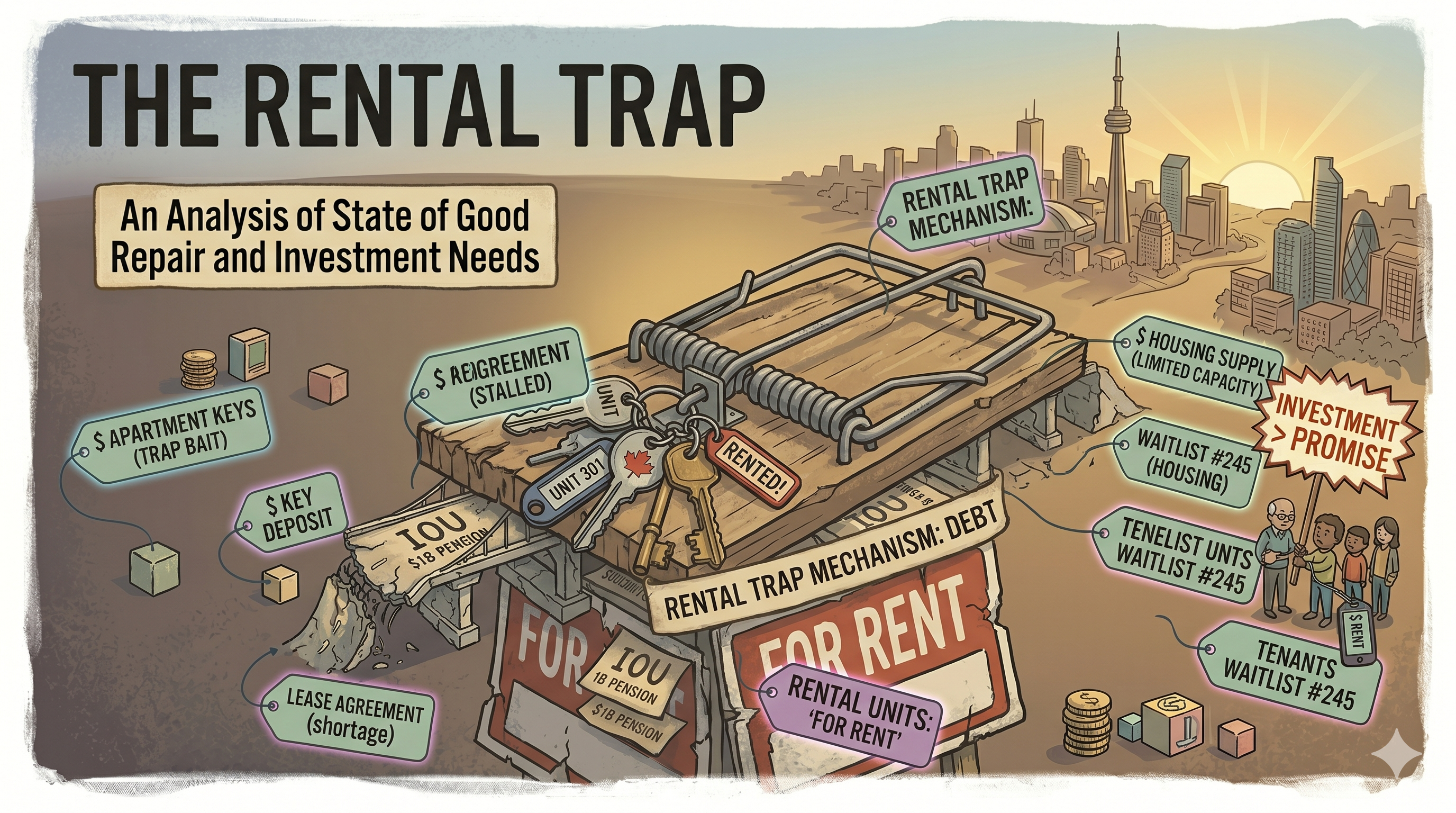
Until then, millions of Canadians will keep doing the grim monthly arithmetic: rent, groceries, transit, phone, internet — and wondering where the money for savings, for a future, for anything beyond survival is supposed to come from. That's not a housing market. That's a trap.
References
[1] Canada Mortgage and Housing Corporation (CMHC). Rental Market Report, 2024-2025. cmhc-schl.gc.ca
[2] Statistics Canada. Census 2021 and Labour Force Survey data on household income and housing tenure. statcan.gc.ca
[3] Parliamentary Budget Officer (PBO). Housing Affordability in Canada, 2024-2025. pbo-dpb.gc.ca
[4] Office of the Federal Housing Advocate. The Financialization of Housing in Canada, 2023. housingchrc.ca