Published on November 5, 2025
On the night of April 28, 2025, Pierre Poilievre didn't just lose the election. He lost his own riding. The leader of the Conservative Party of Canada, the man who spent four years positioning himself as the next prime minister, couldn't convince the voters who know him best to send him back to Ottawa [1].
It was the political equivalent of being fired from the family business.
Poilievre lost Ottawa West-Nepean to a Liberal candidate, becoming the first major party leader in modern Canadian history to be defeated in his own constituency during a general election [2]. The NDP was reduced to 7 seats, below the 12-seat threshold for official party status, a collapse not seen since 1993 [3].
The result: Canada has a Liberal minority government with 169 seats facing a weakened Conservative opposition with no permanent leader and an NDP too small to form official caucus. That's not just a political story. It's an economic one.
Why Losing Matters for Everyone
Opposition parties aren't just an annoyance for the government. They're a check on spending, a voice for alternative economic approaches, and a mechanism for holding the people with power accountable for how they use taxpayer money.
A strong opposition asks hard questions about the $78.3 billion deficit. A strong opposition demands detailed accounting for $141 billion in new spending. A strong opposition forces the government to justify every procurement contract, every policy decision, and every foreign investment deal.
A weak opposition does none of those things effectively.
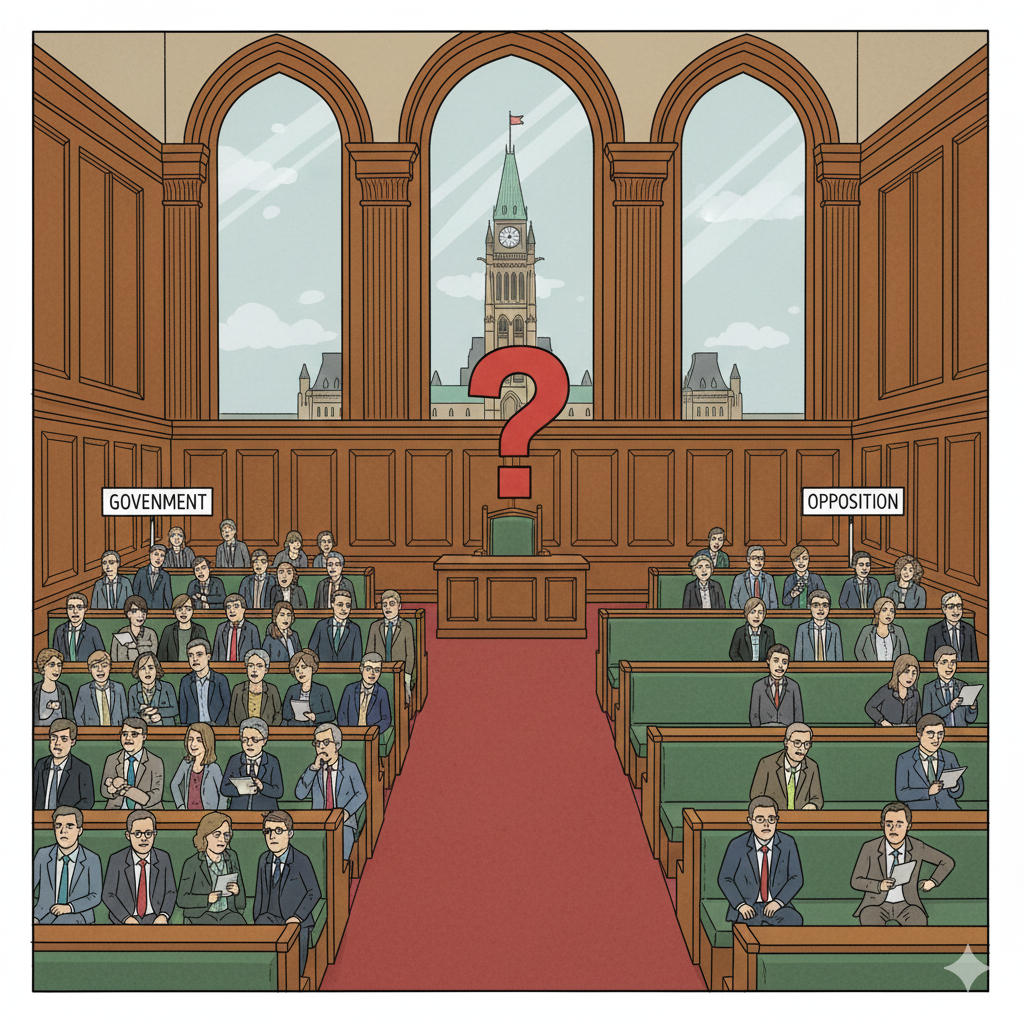
The Conservative Party is currently occupied with an internal leadership contest, debating who they are and what they stand for after a defeat that was supposed to be a victory. The NDP is fighting for survival with 7 seats and limited parliamentary resources. The Bloc Quebecois holds influence in Quebec but has no national platform.
The practical result: Carney's government faces less scrutiny than any minority government in recent memory. The bills pass more easily. The questions are softer. The budget gets less pushback.
Whether you support Carney's agenda or not, the absence of effective opposition is an economic risk. Governments that face weak opposition tend to spend more, because nobody's making them justify the costs [4]. They take bigger risks with public money, because the consequences of failure are politically manageable when there's no credible alternative government waiting in the wings.
How Poilievre Lost His Own Backyard
Ottawa West-Nepean is a suburban riding with a significant proportion of federal public servants [5]. Poilievre spent four years promising to cut government waste, which to the tens of thousands of public servants in his riding sounded a lot like promising to cut their jobs.
The political miscalculation was striking. Conservative populism plays well in rural Alberta and suburban Ontario, but it plays terribly in a city where the federal government is the largest employer. Telling your neighbours you're going to fire some of them isn't a winning door-knocking strategy.
The broader lesson: populist economic messaging has geographic limits. "Axe the tax" resonates with people who see government as a cost centre. It doesn't resonate with people who see government as a pay cheque. Ottawa, as the seat of federal government, was perhaps the worst possible riding for a leader whose entire brand was built on cutting government.
The NDP's Economic Influence, Gone
The NDP's collapse to 7 seats isn't just a loss for the party. It's a loss of economic perspective in Parliament.
For all its limitations, the NDP has historically been the parliamentary voice for labour protections, universal social programs, wealth redistribution, and corporate accountability. The party pushed pharmacare from a campaign promise into legislation. It secured dental care for lower-income Canadians. It forced anti-scab legislation through Parliament [6].
Without the NDP holding even official party status, those priorities lose their loudest parliamentary advocate. The Liberals have historically adopted NDP positions when it's politically useful, then quietly abandoned them when the NDP isn't in a position to enforce compliance.
Pharmacare expansion has already been shelved. Labour protections are lower priority without NDP pressure. Corporate tax reform, wealth taxes, and excess profit levies, all NDP priorities, are absent from Budget 2025.
For lower and middle-income Canadians who benefited from NDP-influenced policy, the 2025 election result means less political representation of their economic interests. The Liberal government may still adopt some progressive economic measures, but without external pressure, the incentive to do so is weaker.
The Conservative Leadership Vacuum
As of this writing, the Conservative Party is in the process of choosing a new leader. The candidates represent different economic visions for the party: fiscal hawks, social conservatives, Red Tories, and populists each making their case.
The leadership race matters economically because the Conservative Party's platform sets the parameters for the economic debate in Canada. When the Conservatives advocate for lower taxes and smaller government, the Liberals position themselves as moderate spenders. When the Conservatives move toward populist economics, the Liberals move toward technocratic competence.
Without a settled Conservative leader and economic platform, the government faces a policy vacuum on its right flank. There's nobody forcing a debate about the deficit trajectory, the long-term cost of the spending commitments, or the assumptions underlying the trillion-dollar investment plan.
That debate will eventually happen. When the new Conservative leader emerges, they'll inherit a government that has spent nearly a year without serious economic challenge. The accumulated spending commitments will be harder to reverse. The political investments in trade deals, housing programs, and military spending will have their own constituencies defending them.
The longer the opposition vacuum lasts, the more permanent Carney's economic framework becomes, regardless of whether it's the right one.
The Historical Pattern
Canada has seen opposition collapses before. In 1993, the Progressive Conservatives were reduced to 2 seats, effectively destroying the party for a generation. The Liberals governed with massive majorities through the 1990s and early 2000s.
That period produced the Chretien-Martin fiscal discipline era: balanced budgets, debt reduction, and program cuts. It also produced the sponsorship scandal, which thrived partly because there was no effective opposition to catch it early [7].
The pattern is consistent: weak opposition correlates with bolder government action, both good and bad. The same conditions that allow a competent government to pursue ambitious reform also allow an overconfident government to cut corners, overspend, and make decisions without adequate debate.
Carney is, by all appearances, competent. But competence without accountability is still a risk. The best economic decisions are ones that have survived rigorous challenge. The worst are ones that were never challenged at all.
The Bottom Line
The 2025 election produced an unusual economic governance situation: a minority government with majority-like freedom because the opposition is too fragmented to oppose effectively.
For Carney, this is an opportunity to pursue ambitious economic restructuring without the usual parliamentary trench warfare. The trade diversification strategy, the defence spending increase, the housing program, and the budget's $141 billion in new spending all face less resistance than they would in a parliament with a strong opposition.
For Canadians, it means the usual checks on government spending are weaker than normal. The questions aren't being asked as forcefully. The alternatives aren't being presented as clearly. And the accountability that comes from knowing the other party could form government tomorrow is absent.
Pierre Poilievre's personal defeat is a footnote. The economic consequence of having no effective opposition is the story. Government works best when someone credible is pushing back, questioning the assumptions, challenging the numbers, and offering different answers to the same problems.
Right now, nobody is. And that should concern everyone, regardless of which party they voted for.
References
[1] CBC News. "Poilievre loses Ottawa West-Nepean seat." April 28, 2025.
[2] Elections Canada. "Historical Riding Results: Ottawa West-Nepean." 2025.
[3] Elections Canada. "43rd General Election: Official Results by Party." April 28, 2025.
[4] Besley, Timothy and Anne Case. "Political Competition and Government Performance." Journal of the European Economic Association. 2003.
[5] Statistics Canada. "Census Profile: Ottawa West-Nepean Federal Electoral District." 2021.
[6] Parliament of Canada. "Legislative Summary: NDP-Liberal Supply and Confidence Agreement." 2022-2025.
[7] Gomery, John. "Commission of Inquiry into the Sponsorship Program and Advertising Activities." 2005.