Published on March 1, 2026
Imagine you throw a dinner party for ten people. You've got enough chairs, enough plates, and a casserole that could feed a small army. Great evening. Now imagine you throw that same dinner party, but forty people show up, and you still have ten chairs. The casserole hasn't magically tripled. The bathroom situation gets dire around hour two.
That, in a nutshell, is Canada's immigration-versus-infrastructure problem.
Nobody reasonable disputes that Canada needs immigration. The country's fertility rate sits at 1.33 children per woman, well below the 2.1 replacement level [1]. Without newcomers, the population ages, the tax base shrinks, and the ratio of workers supporting retirees gets ugly fast. By 2030, roughly one in four Canadians will be over 65 [2]. Someone needs to keep the economy running while the boomers enjoy their retirement cottages in Muskoka.
But between the economic necessity of immigration and the lived reality of cities that can't build fast enough, there's a gap wide enough to drive a moving truck through. And over the past few years, Canada has been driving a fleet of them.
The Numbers, Plain and Simple
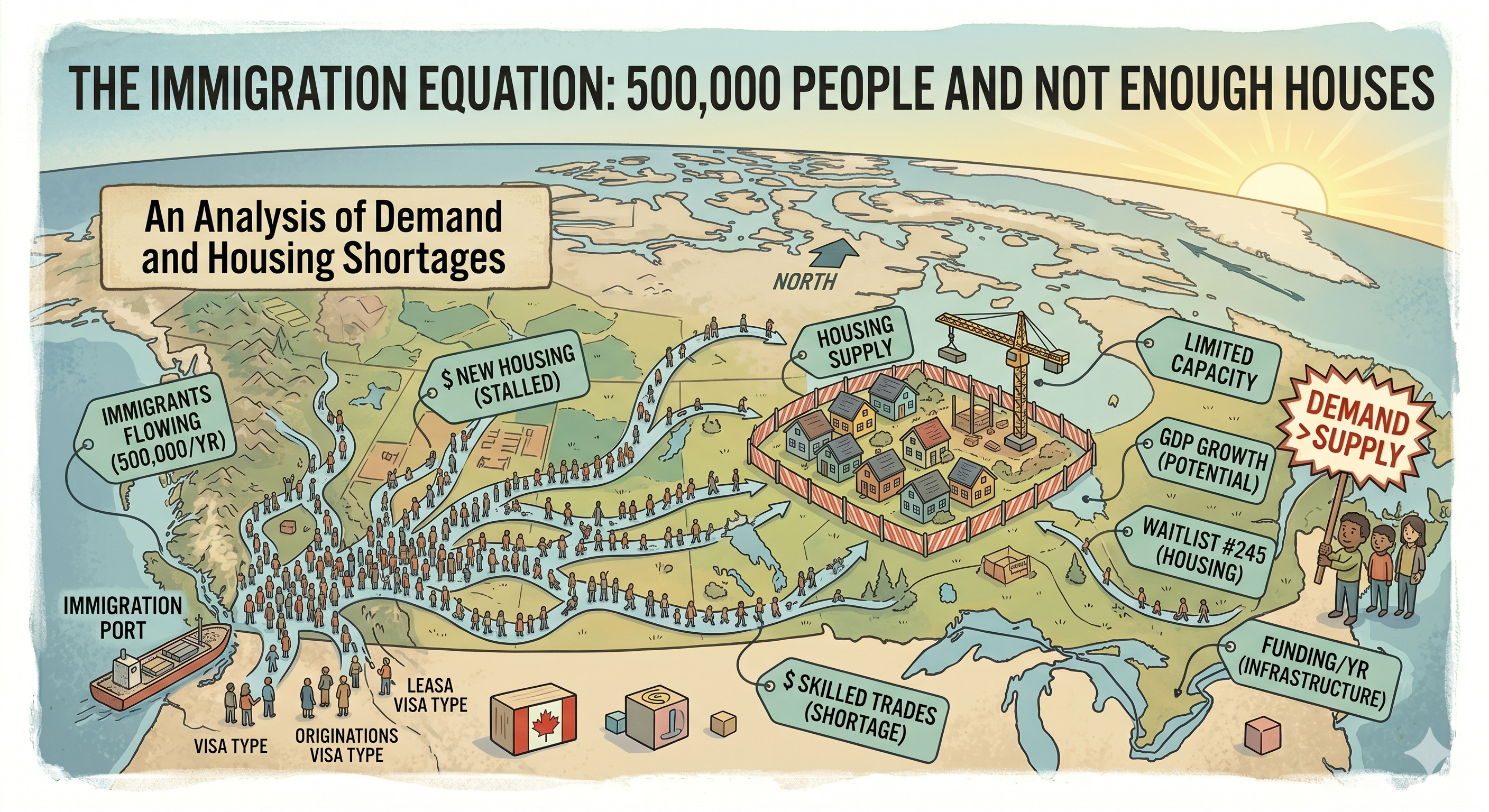
Canada admitted 471,550 permanent residents in 2023, up from 405,000 in 2022 and roughly 341,000 in 2019 [3]. The federal government's Immigration Levels Plan initially targeted 500,000 permanent residents annually by 2025, before pulling back targets in late 2024 amid mounting political pressure.
But permanent residents are only part of the picture. Canada's temporary resident population exploded in recent years. By mid-2024, there were approximately 2.8 million temporary residents in the country, including international students, Temporary Foreign Workers (TFWs), and asylum claimants [4]. That's nearly triple the figure from five years earlier.
Add it all up, and Canada's population grew by over 1.2 million people in 2023 alone, a 3.2% growth rate that hadn't been seen since the 1950s baby boom [5]. For a country that builds roughly 240,000 housing units per year, those numbers create a problem that doesn't require an economics degree to understand.
The Housing Math That Keeps Economists Up at Night
CMHC estimated in 2023 that Canada needs to build 3.5 million additional homes by 2030 to restore housing affordability [6]. That's on top of the roughly 2.3 million units expected to be built at current rates. In total, the country would need approximately 5.8 million new homes by 2030, which translates to roughly 830,000 units per year.
Canada has never built 830,000 housing units in a single year. Not once. The record year was 1972, with about 250,000 starts. Recent years have hovered around 220,000 to 260,000 [7].
So picture the arithmetic. Every year, hundreds of thousands of newcomers arrive needing homes. Every year, Canada builds roughly a quarter of what's required. The backlog grows. Rents climb. The dream of homeownership that attracted many immigrants in the first place drifts further from reality, not just for newcomers, but for everyone.
This isn't an immigration problem exclusively. Canada underbuilt housing for decades before the recent population surge. Municipal zoning restrictions, slow permitting processes, skilled labor shortages in the trades, and insufficient infrastructure investment all contributed to a structural deficit that immigration has accelerated but didn't create.
What a Doctor Shortage Actually Looks Like
Walk into an emergency room in any mid-sized Canadian city and you'll get a firsthand lesson in capacity constraints. The average ER wait time in Canada was 3.4 hours in 2023, with some provinces averaging over four hours [8]. In parts of New Brunswick, Nova Scotia, and rural Ontario, emergency departments have been periodically closing entirely due to staffing shortages.
Canada has approximately 2.8 physicians per 1,000 people, below the OECD average of 3.7 [9]. About 6.5 million Canadians lack a family doctor, a number that's been steadily climbing [10]. Foreign-trained physicians face credential recognition processes that can take years, meaning a doctor who immigrates to Canada might spend considerable time unable to practice.
The irony is thick: Canada admits hundreds of thousands of people partly to address labor shortages, including in healthcare, while the credential recognition system prevents many healthcare-trained immigrants from actually working in their field. The bottleneck isn't talent supply. It's bureaucratic throughput.
Provincial healthcare systems, funded through a combination of federal transfers and provincial revenue, were already stretched before the population surge. The Canada Health Transfer grows at a guaranteed minimum of 3% annually, but provincial healthcare costs have been rising at 5-6% [11]. More people arriving means more patients in a system that was already running on fumes.
Toronto and Vancouver vs. Everyone Else
Immigration's impact varies wildly depending on where you look. Greater Toronto and Greater Vancouver absorb a disproportionate share of newcomers, roughly 40-45% of all immigrants to Canada settle in these two metro areas [12].
Toronto's rental vacancy rate sat at around 2.1% in late 2024, up from historic lows but still tight enough to keep rents elevated. Average rent for a one-bedroom apartment exceeded $2,400 per month [13]. Vancouver's numbers are comparable. In both cities, the combination of population growth and constrained housing supply has created affordability crises that are reshaping who can afford to live there.
Meanwhile, Atlantic Canada tells a different story. Provinces like New Brunswick, Nova Scotia, and Prince Edward Island have actively courted immigration through Provincial Nominee Programs to combat population decline and aging demographics. Moncton, Halifax, and Charlottetown have seen population growth they hadn't experienced in generations.
The challenge in smaller communities is different but real. A town of 30,000 that gains 3,000 residents in two years needs more school seats, more doctors, expanded transit, and upgraded water and sewer infrastructure. These are places where a single new subdivision can overwhelm the existing road network. The growth is welcome, even essential, but the infrastructure can't appear overnight any more than it can in Toronto.
The Temporary Resident Explosion (and Course Correction)
The most dramatic shift in recent years wasn't in permanent immigration. It was in temporary residents. International student enrollment surged from about 640,000 in 2019 to over 1 million by 2023 [14]. The Temporary Foreign Worker Program expanded significantly, particularly in lower-wage sectors.
The international student boom was driven by a feedback loop that benefited nearly everyone in the short term. Colleges and universities, especially private institutions, received tuition revenue. Students received a pathway to permanent residency. The federal government could point to economic activity and future taxpayers. Provincial governments got population growth without having to fund it directly.
The long-term costs were less visible but significant. Students concentrated in a handful of cities, competing for the same rental housing stock as everyone else. Reports of exploitative conditions at some private colleges raised questions about program integrity. And when hundreds of thousands of study permit holders expected a transition to permanent residency, the system faced a pipeline problem it hadn't planned for.
The federal government announced caps on international study permits in early 2024 and has since tightened TFW program rules. Temporary resident numbers have started declining. These corrections were necessary, but they also disrupted the plans of hundreds of thousands of people who had made life decisions based on previous policy signals. Moving the goalposts after people have already started running creates its own costs, measured in human terms rather than economic ones.
What the Economists Actually Say
Most economists who study Canadian immigration land in roughly the same place: immigration is economically necessary, the recent pace was too fast for infrastructure to absorb, and the composition of immigration matters as much as the quantity.
The Conference Board of Canada has consistently argued that immigration is essential to maintain workforce growth and support an aging population [15]. The Parliamentary Budget Officer has noted that immigrants make a net positive fiscal contribution over their lifetimes, though the benefits take time to materialize, typically 10-20 years after arrival [16].
Where economists diverge from the political conversation is on specificity. The economic case for immigration is strongest when newcomers fill genuine labor market gaps in high-productivity sectors. An immigrant software engineer, nurse, or skilled tradesperson generates substantial economic returns relatively quickly. The case weakens when immigration primarily fills low-wage positions that suppress wages for existing workers, particularly recent immigrants themselves.
Per-capita GDP tells part of this story. Canada's real GDP grew in 2023, but real GDP per capita actually declined for several consecutive quarters [17]. The economy got bigger in absolute terms but each individual's slice got smaller. That's the difference between a growing economy and a prospering one.
The politically difficult recommendation that most economists would make, if anyone asked, is that Canada should aim for immigration levels calibrated to infrastructure capacity, with heavy emphasis on economic-stream immigrants in high-demand fields, paired with massive investment in housing, healthcare, and credential recognition. The target shouldn't be a round number chosen for political appeal. It should be a variable number tied to measurable absorption capacity: housing starts, healthcare staffing ratios, settlement service availability.
Nobody campaigns on "evidence-based variable immigration targets tied to infrastructure metrics." It doesn't fit on a lawn sign. But it's probably the right answer.
The Bottom Line
Canada's immigration debate suffers from a chronic case of false dichotomy. One side insists any criticism of immigration levels is thinly veiled xenophobia. The other side treats immigration itself as the source of every affordability problem in the country. Both positions are intellectually lazy and neither helps anyone find a house or a family doctor.
The reality is that Canada needs immigration like a hockey team needs a deep bench: you can't win without it, but acquiring twelve new forwards when you don't have enough sticks or ice time doesn't make you a better team. It makes you chaotic.
The federal government's recent pullback on temporary residents and more cautious permanent immigration targets suggest the math is starting to register politically. Whether that translates into the kind of sustained infrastructure investment required to actually absorb population growth remains an open question. Building houses, training doctors, and expanding transit takes years. Political cycles run in months.
For now, Canada finds itself in the awkward position of a country that correctly identified immigration as essential to its economic future but treated the logistics of absorbing a million-plus people per year as someone else's problem. The economics were right. The execution needed work. And somewhere in Brampton, forty people are still sharing ten chairs.
References
- Statistics Canada, "Fertility rate, 1926 to 2023," The Daily, September 2024.
- Statistics Canada, "Population Projections for Canada, Provinces and Territories," Catalogue no. 91-520-X.
- Immigration, Refugees and Citizenship Canada (IRCC), "2023 Annual Report to Parliament on Immigration."
- Statistics Canada, "Estimates of temporary residents," The Daily, March 2024.
- Statistics Canada, "Canada's population estimates, Q4 2023," The Daily, March 2024.
- Canada Mortgage and Housing Corporation (CMHC), "Canada's Housing Supply Shortages," September 2023.
- CMHC, "Housing Starts Data," historical tables, 2024.
- Canadian Institute for Health Information (CIHI), "Your Health System: Wait Times for Emergency Departments," 2023.
- OECD, "Health at a Glance 2023: OECD Indicators," Physicians per 1,000 population.
- Statistics Canada, "Primary health care providers, 2023," Canadian Community Health Survey.
- Parliamentary Budget Officer, "Federal Health Transfers: Trends and Sustainability," 2024.
- Statistics Canada, "Immigration and Ethnocultural Diversity," 2021 Census analysis.
- CMHC, "Rental Market Report," October 2024.
- IRCC, "Canada — Study permit holders by province/territory," open data portal, 2024.
- Conference Board of Canada, "Can We Afford Not to Grow? Immigration and Long-Term Economic Growth," 2024.
- Parliamentary Budget Officer, "Fiscal Sustainability of Federal Immigration Programs," 2023.
- Statistics Canada, "Gross domestic product, income and expenditure," quarterly national accounts, 2024.