Published on November 25, 2025
I wrote about Canadian healthcare economics back in May, questioning whether "free" healthcare is really free when Canadians spend $8,019 per person annually and wait months for basic procedures. My conclusion: the system works, sort of, but it's held together with overtime shifts and good intentions.
Since then, Mark Carney ran for Prime Minister on a platform that included thousands more doctors, new medical schools, expanded residency positions, $4 billion for hospital construction and renovation, national physician and nurse licensing, and cutting wait times [1].
Then he won.
Then his Health Minister, Marjorie Michel, said that economic uncertainty makes it "impossible" to release the $4 billion in health funding [2]. She also ruled out new federal team-based primary care programs, citing provincial jurisdiction [2]. And when asked about expanding the pharmacare program that the NDP had secured under Trudeau, Carney refused to commit [3].
"Impossible" is a strong word when you've just tabled a budget with $141 billion in new spending.
The Campaign vs. the Budget
Campaign promises and budget line items exist in different universes. On the campaign trail, healthcare reform is emotional, urgent, and specific. In the budget, it's a line item competing with defence spending, housing, trade diversification, and deficit reduction.
Budget 2025 included healthcare funding, but it was notably less specific and less generous than the campaign rhetoric suggested. The $4 billion for hospital construction was deferred indefinitely. The "thousands more doctors" translated to funding frameworks rather than specific recruitment targets. National physician licensing, which would let a doctor trained in Ontario practice in Nova Scotia without recertification, was described as a goal rather than a legislative mandate [4].
The gap between promise and delivery isn't unique to Carney. Every Canadian prime minister since Medicare was established has promised to fix healthcare. None have fully succeeded, partly because the Constitution puts health under provincial jurisdiction, and partly because the cost of genuinely fixing the system exceeds what any government wants to spend.
Why Healthcare Keeps Getting Deferred
Healthcare is the largest single expenditure in Canadian public finance. Provincial governments spend roughly 40% of their budgets on health [5]. Federal transfers through the Canada Health Transfer contribute about $50 billion annually [6]. Combined, Canada spends approximately 12.2% of GDP on healthcare, among the highest in the OECD [7].
Despite that spending, outcomes are mediocre by international standards. Canada ranks near the bottom of comparable countries on wait times, access to family physicians, and hospital capacity [8]. We spend more than most European countries and get worse results.
The problem isn't money alone. It's how the money is spent, how the system is structured, and how federal-provincial politics prevents the kind of coordinated reform that's needed.
The federal government can't hire doctors. Provinces do that. The federal government can't build hospitals. Provinces do that. The federal government can't change how emergency rooms are staffed or how surgical schedules are managed. All provincial.
What the federal government can do is provide funding with conditions attached, creating incentives for provinces to reform. The Canada Health Transfer does this to some extent: provinces must maintain universal, accessible, publicly funded healthcare to receive federal money.
But attaching new conditions to new money means picking fights with provinces. Alberta's premier has been pursuing healthcare privatization. Quebec manages its own system with distinct priorities. Ontario's approach differs from British Columbia's. Getting ten provinces and three territories to agree on healthcare reform is like getting thirteen cats to walk in a straight line.
The Doctor Shortage by the Numbers
Canada has approximately 92,000 physicians, or about 2.4 doctors per 1,000 people [9]. The OECD average is 3.7 [7]. To reach the OECD average, Canada would need roughly 50,000 more doctors.
Training a doctor takes 8-12 years after high school: four years of undergraduate study, four years of medical school, and 2-5 years of residency training. Even if Canada dramatically expanded medical school enrollment tomorrow (which would require building new medical schools, hiring faculty, and creating residency positions), the first additional doctors wouldn't enter practice until the mid-2030s.
The faster alternative is recruiting internationally trained doctors and streamlining their licensing process. Canada already does this, but the process is slow and inconsistent across provinces. A physician trained in the UK, with years of practice experience, can wait years for Canadian licensing approval while working in non-medical jobs.
National physician licensing, one of Carney's campaign promises, would help by creating a single credential recognized across all provinces. But it requires provincial agreement, which brings us back to the thirteen cats problem.
Pharmacare: The Promise That Wasn't
Under the Liberal-NDP supply and confidence agreement, Canada established the beginning of a national pharmacare program, covering diabetes medication and contraception [10]. It was a modest start toward a system that would eventually provide universal drug coverage, reducing the number of Canadians who can't afford their prescriptions.
Carney has refused to commit to expanding pharmacare [3]. The NDP, which made pharmacare a condition of supporting the Liberals, was reduced to 7 seats in the April election and lost official party status [11]. Without NDP leverage, the political pressure to expand the program evaporated.
For the roughly 3.7 million Canadians who don't have prescription drug coverage [12], this means continued out-of-pocket costs that other developed countries have largely eliminated. A Canadian with diabetes gets their insulin covered. A Canadian with heart disease still pays for their medication. The line between covered and not-covered is political, not medical.
The Privatization Question
Alberta Premier Danielle Smith has been moving toward allowing more private delivery of publicly funded healthcare services [13]. The idea: let private clinics perform surgeries and diagnostics, paid for by the public system, to reduce wait times.
Carney has avoided condemning this approach, which is notable for a Liberal prime minister. The traditional Liberal position on healthcare privatization has been firmly opposed. Carney's silence suggests either pragmatic acceptance of provincial autonomy or a calculation that picking a fight with Alberta over healthcare would undermine the pipeline deal and broader federal-provincial relations.
The economic evidence on private delivery of publicly funded healthcare is mixed. Some studies show faster service delivery. Others show cream-skimming, where private clinics take the easiest, most profitable cases and leave the complex, expensive ones to the public system. The net effect on total system efficiency is debatable and depends heavily on implementation details [14].
For Canadians waiting months for surgery, the theoretical debate matters less than the practical question: will they get treatment faster? If private clinics reduce wait times without increasing total costs or reducing access for lower-income patients, most people wouldn't object regardless of the ideology.
Whether Alberta's model achieves that remains to be seen. The early results are too limited to draw conclusions.
The Bottom Line
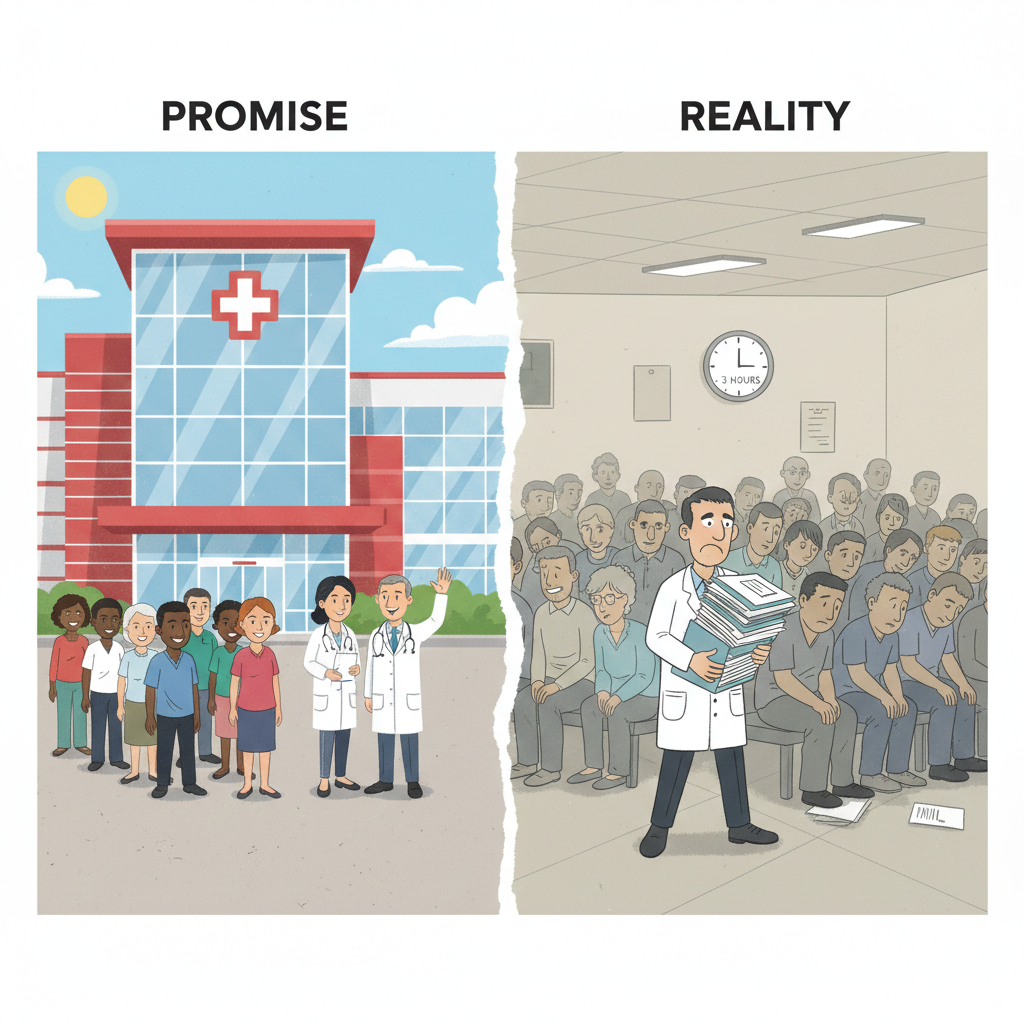
Canada's healthcare system needed reform before the election. It still needs reform after the election. The campaign promises raised expectations. The budget deferred delivery. The health minister's "impossible" framing lowered expectations further.
None of this is surprising. Healthcare reform in Canada has been promised, deferred, and diluted by every government in living memory. The jurisdictional structure makes it genuinely difficult. The costs make it genuinely expensive. And the political incentives favour promising improvement over delivering it.
Carney's contribution to this pattern is the gap between his campaign's ambition and his government's delivery. "Thousands more doctors" became a licensing framework. "$4 billion for hospitals" became "impossible" within months. Pharmacare expansion became silence.
For the Canadian who can't find a family doctor, who waits eight months for a knee replacement, who skips prescription medications because they can't afford them, the distinction between a promise and a policy is the difference between hope and help.
So far, healthcare has gotten the hope. The help is still waiting in the queue.
References
[1] Liberal Party of Canada. "2025 Election Platform: Healthcare Commitments." 2025.
[2] CBC News. "Health minister says economic uncertainty makes health funding release 'impossible.'" 2025.
[3] Globe and Mail. "Carney declines to commit to pharmacare expansion." 2025.
[4] Department of Finance Canada. "Budget 2025: Health Measures." November 2025.
[5] Canadian Institute for Health Information. "Provincial Health Spending Trends." 2025.
[6] Department of Finance Canada. "Canada Health Transfer." 2025-26 Estimates.
[7] OECD. "Health at a Glance 2024: Canada." 2024.
[8] Commonwealth Fund. "Mirror, Mirror 2024: Reflecting on Health System Performance in 11 Countries." 2024.
[9] Canadian Institute for Health Information. "Physicians in Canada." 2025.
[10] Government of Canada. "Canadian Drug Agency and National Pharmacare." 2024.
[11] Elections Canada. "43rd General Election Official Results." April 28, 2025.
[12] Angus Reid Institute. "Prescription Drug Coverage in Canada." 2024.
[13] Government of Alberta. "Alberta Surgical Initiative." 2025.
[14] Tuohy, Carolyn Hughes. "Remaking Policy: Scale, Pace, and Political Strategy in Health Care Reform." University of Toronto Press. 2019.