Published on February 1, 2026
I wrote about the great Canadian grocery bill mystery a year ago, trying to figure out why a bag of apples costs what it costs and who's getting the extra money. Since then, the government has responded with the Canada Groceries and Essentials Benefit, which is a fancy way of saying "we can't fix the prices, so here's some cash" [1].
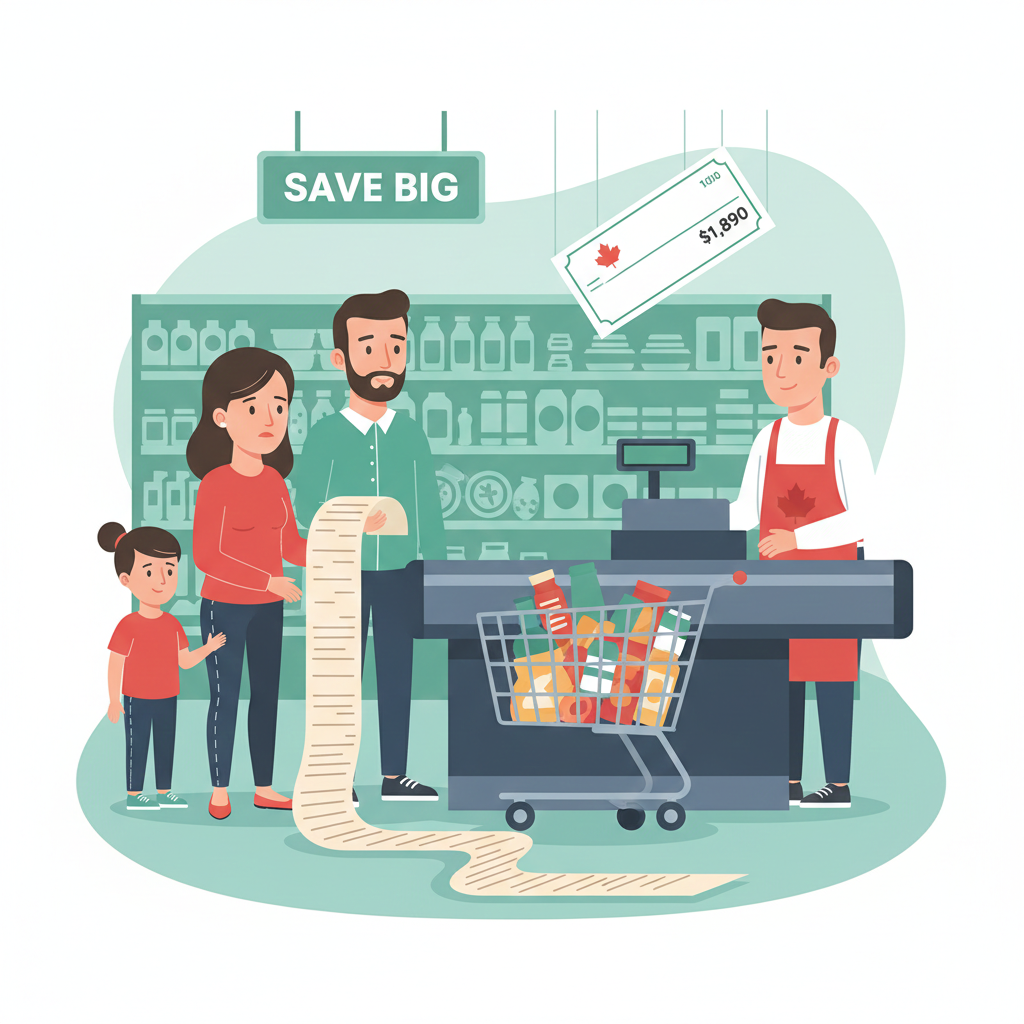
Starting in January 2026, the GST credit gets a 25% boost for five years beginning July 2026. This year, the increase is even bigger: a one-time 50% bump. For a family of four, that means up to $1,890 this year, settling to about $1,400 per year after that [2].
Twelve million Canadians qualify [2]. That's roughly a third of the population getting a cheque specifically because groceries and everyday costs have gotten out of hand.
The question isn't whether the money helps. It does. Twelve hundred extra dollars buys groceries. The question is whether writing cheques to help people cope with high prices is the same thing as actually making prices lower. It's not. And that distinction matters.
How the Benefit Works
The Groceries and Essentials Benefit isn't a new program. It's an increase to the existing GST/HST credit, which is a quarterly payment that lower and middle-income Canadians already receive to offset the regressive nature of consumption taxes [3].
The GST credit is income-tested. Higher-income households get less or nothing. The maximum benefit goes to individuals earning under roughly $40,000 and families earning under roughly $60,000. The benefit phases out gradually above those thresholds.
A single person receives up to about $945 this year (the 50% bump year), settling to around $700 annually. A couple with two children receives up to $1,890 this year, settling to about $1,400 [2].
The total cost to the government: $12.4 billion over six years [2]. That's real money, funded through the same deficit that's already running at $78.3 billion this year.
What $1,890 Buys at the Grocery Store
The average Canadian family of four spent $16,297 on food in 2025, according to Dalhousie University's Food Price Report [4]. That's about $313 per week.
The $1,890 benefit covers roughly six weeks of groceries. One-and-a-half months of food for a family. After this year's one-time bump, $1,400 annually covers about four-and-a-half weeks.
That's helpful. Nobody would turn it down. But it's a supplement, not a solution. The underlying problem, that food prices increased by roughly 20-25% between 2021 and 2025 [5], remains fully intact. The benefit offsets a fraction of that increase for qualifying families without addressing why prices went up or whether they'll keep going up.
Why Prices Are Still High
Food prices rose for reasons that a government cheque can't fix.
Global commodity markets drove grain, cooking oil, and fertilizer prices up during the Ukraine conflict [6]. Supply chain disruptions during and after the pandemic increased transportation and logistics costs. Labour shortages in agriculture, food processing, and retail pushed wages up, which employers passed on to consumers.
In Canada specifically, market concentration in the grocery sector means three companies, Loblaws, Empire (Sobeys), and Metro, control roughly 60% of grocery retail [7]. When three companies dominate a market, price competition is limited. Prices can rise faster than costs because consumers have nowhere else to go.
The carbon tax, which I covered extensively before it was eliminated, contributed approximately 0.15 percentage points to inflation annually [8]. Removing it helped slightly at the pump but didn't fundamentally change grocery dynamics.
None of these factors are addressed by the Groceries and Essentials Benefit. The benefit treats the symptom (people can't afford food) without treating the disease (food costs too much relative to incomes).
Cash Transfers vs. Structural Reform
Economists broadly agree that targeted cash transfers are one of the better ways to help people cope with rising costs [9]. They're efficient (money goes directly to those who need it), flexible (people can spend it on whatever they need most), and administratively simple (piggybacking on the existing GST credit system means no new bureaucracy).
The alternative, structural reform to reduce food prices, is harder, slower, and politically dangerous.
Increasing grocery competition would require breaking up or regulating the three dominant chains. That's a decade-long regulatory fight with uncertain outcomes. Reforming supply management in dairy, poultry, and eggs would lower prices but devastate farming communities that depend on the current system. Investing in domestic food processing to reduce import dependence requires capital and years of capacity building.
Cash transfers are the fast option. Structural reform is the effective option. The government chose fast, which is what governments almost always do, because cheques arrive before the next election and structural reforms don't.
The School Food Program
Bundled with the grocery benefit is the permanent funding of the National School Food Program, providing meals for up to 400,000 children per year and saving families roughly $800 annually [10].
This is one of those policies where the economics and the ethics line up cleanly. Hungry kids don't learn well. Kids who don't learn well earn less as adults. Feeding children in school produces measurable returns in educational achievement, health outcomes, and long-term economic productivity [11].
Most developed countries have had national school food programs for decades. Canada's late arrival to this table is one of those quiet national embarrassments that's easy to overlook because it doesn't generate headlines the way housing or trade wars do.
Making it permanent, rather than year-to-year funded, gives school boards the certainty to plan and staff properly. It's good policy by almost any measure.
The Bottom Line
The Canada Groceries and Essentials Benefit puts real money in the pockets of Canadians who need it. Twelve million people will receive payments that meaningfully offset a fraction of the cost-of-living increase they've experienced over the past four years.
It does not fix food prices. It does not address market concentration in grocery retail. It does not solve the structural issues that made food unaffordable in the first place. It's a bandage on a wound that needs stitches.
The school food program is genuinely good policy that will improve outcomes for hundreds of thousands of children.
Together, they represent a government that has chosen to manage the cost-of-living crisis through income support rather than market reform. That's a defensible choice in the short term, an expensive choice in the medium term, and an incomplete choice in the long term.
For the family of four receiving $1,890 this year, none of that analysis changes the fact that the cheque helps. Sometimes that's enough to get through the month. Whether it's enough to fix the problem is a question for a different timeline.
References
[1] Prime Minister of Canada. "New Measures to Make Groceries and Other Essentials More Affordable." January 26, 2026.
[2] Department of Finance Canada. "Canada Groceries and Essentials Benefit: Program Details." 2026.
[3] Canada Revenue Agency. "GST/HST Credit." 2025.
[4] Dalhousie University. "Canada's Food Price Report 2025." December 2024.
[5] Statistics Canada. "Consumer Price Index: Food Component." Table 18-10-0004-01. 2025.
[6] FAO. "Food Price Index: Global Trends 2021-2025." 2025.
[7] Competition Bureau of Canada. "Grocery Sector Market Study." 2023.
[8] Statistics Canada. "Contribution of Carbon Pricing to Consumer Price Index Inflation." 2024.
[9] Banerjee, Abhijit and Esther Duflo. "Good Economics for Hard Times." PublicAffairs. 2019.
[10] Prime Minister of Canada. "National School Food Program: Permanent Funding." 2025.
[11] Gundersen, Craig. "The Economics of School Meal Programs." Journal of Policy Analysis and Management. 2015.