Published on March 10, 2026
You have a baby. Congratulations. You also have a mortgage, a car payment, and two incomes that you very much need to keep flowing. So about four months into parental leave, you start looking into daycare. You Google "daycare near me," make a few calls, and discover something remarkable: the waitlist at the closest licensed centre started accepting names approximately when your child was conceived. Some places have waitlists you need to join before conception, which raises some uncomfortable questions about family planning and municipal bureaucracy.
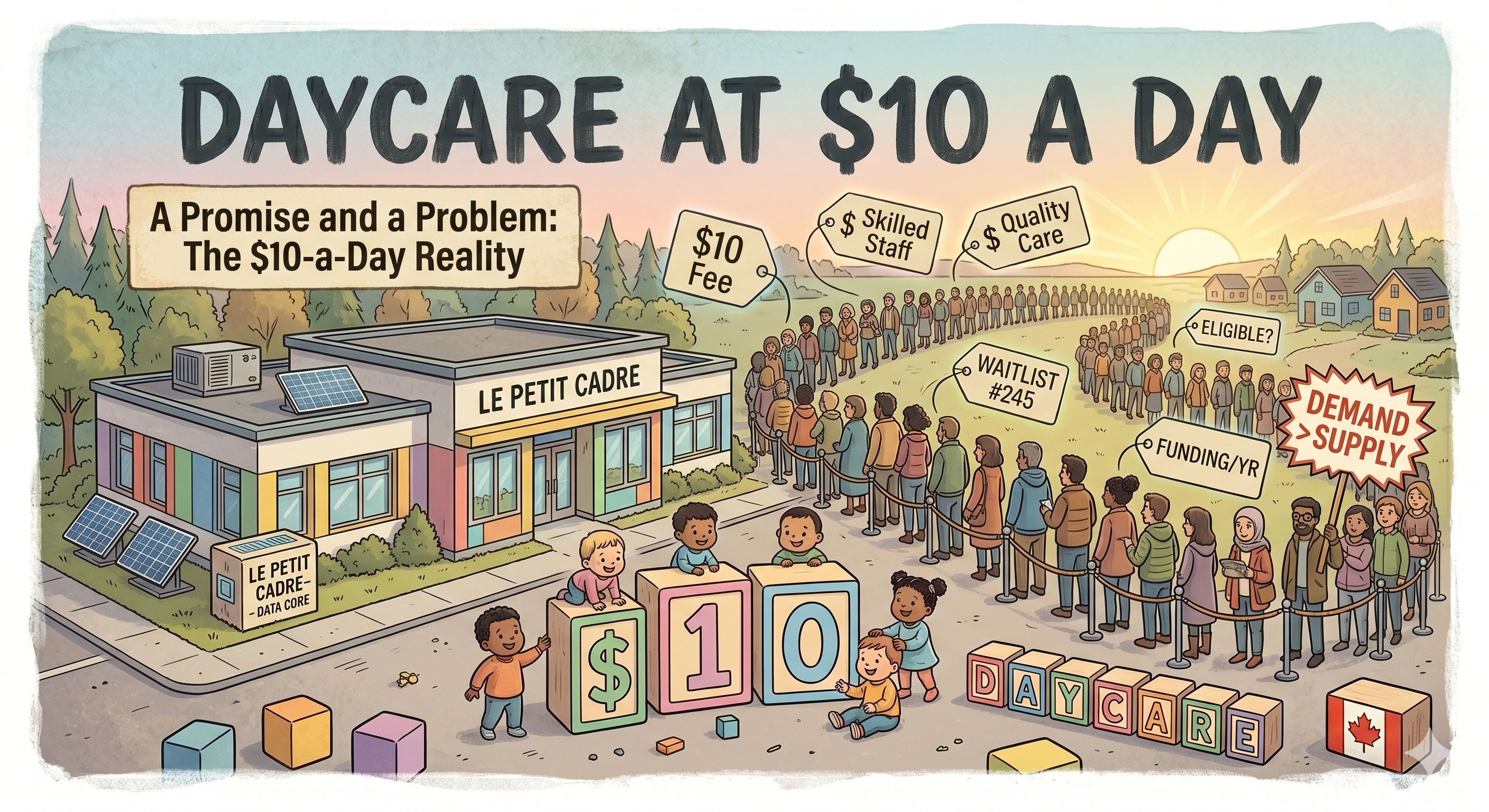
The federal government promised $10-a-day childcare. That promise, on paper, is one of the most important economic policies Canada has introduced in a generation. Affordable childcare isn't a nice-to-have social program. It's infrastructure. It's the thing that allows a massive chunk of the workforce — disproportionately women — to actually participate in the economy.
But between the promise and the reality sits a gap wide enough to park a minivan in. A minivan full of toddlers who have nowhere to go during working hours.
The Canada-wide Early Learning and Child Care (CWELCC) system, announced in the 2021 federal budget, committed $30 billion over five years to reduce childcare fees to an average of $10 a day by March 2026 [1]. Every province and territory signed bilateral agreements with Ottawa. Fees have dropped significantly in many places. And yet, hundreds of thousands of families still can't find a spot.
The economics of why that's happening are worth understanding, because this is a case study in what happens when you subsidize demand without building supply.
What Families Are Actually Paying
Credit where it's due: fees have come down substantially. Before the CWELCC agreements, the median monthly fee for infant care in Toronto was around $1,774. In 2025, participating centres in Ontario charged roughly $22 per day, down from over $80 [2]. That's meaningful savings — roughly $1,300 a month for families who can access a participating spot.
But the picture varies wildly by province. Quebec, which has run its own subsidized childcare program since 1997, charges $9.10 per day [3]. British Columbia has brought fees down to around $15-20 per day for children under three in participating centres [4]. Alberta and the Maritime provinces have seen reductions, but availability of participating spaces remains inconsistent.
The critical word in all of this is "participating." Not every childcare centre has opted into the federal system. Private operators who stay outside the program can charge whatever the market will bear, and in cities like Toronto and Vancouver, that market will bear a lot. Families who can't find a participating spot end up paying $60-80 a day or more — effectively subsidizing their neighbours who got lucky with the waitlist.
Quebec Ran This Experiment 25 Years Ago
If you want to know what happens when you make childcare affordable at scale, look at Quebec. They've been doing this since 1997, when the provincial government introduced $5-a-day childcare (now $9.10, adjusted for inflation) [3].
The results are about as clear as economic data gets. Female labour force participation in Quebec rose from 64% in 1997 to approximately 87% by 2019, surpassing every other province and most comparable jurisdictions internationally [5]. Quebec went from having the lowest female workforce participation rate among large provinces to having the highest. That's not a coincidence.
Pierre Fortin, an economist at UQAM, estimated that Quebec's childcare program generated $5.2 billion in additional economic activity annually and was essentially self-financing through increased tax revenue from working parents [6]. Think about that for a second. A government program that costs money and makes money at the same time. Economists rarely get to point at something that clean.
But Quebec's program also demonstrates the supply problem. Even after 25 years, the province still has waitlists. As of 2023, approximately 37,000 children were on waiting lists for subsidized spots in Quebec [7]. Twenty-five years in, and they still haven't fully solved the supply side. That should tell you something about the timeline the rest of Canada is working with.
The Waitlist Problem Is a Math Problem
Across Canada, there are approximately 640,000 regulated childcare spaces for children aged 0-5 [8]. There are roughly 2.2 million children in that age range [9]. Even accounting for families who don't need or want formal childcare — those with a stay-at-home parent, informal arrangements with family, or children in part-time care — the gap between supply and demand is enormous.
The federal government committed to creating 250,000 new childcare spaces as part of the CWELCC plan [1]. By late 2025, progress on new space creation had been uneven. Some provinces reported strong gains in converting existing spaces to the subsidized program but slower progress in creating net new spots [10].
This distinction matters. Converting an existing $80-a-day spot to a $10-a-day spot is important for the family that already has that spot. But it doesn't help the family on the waitlist. Only net new spaces do that. And creating new spaces requires buildings, equipment, licensing, inspections, and — most critically — people to work in them.
You Can't Run a Daycare Without Daycare Workers
This is where the entire plan runs into a wall, and it's the same wall that the housing plan ran into: you need workers to deliver the service, and the workers aren't there.
Early Childhood Educators (ECEs) in Canada earn, on average, between $18 and $25 per hour, depending on the province [11]. That's for a job that requires a two-year college diploma at minimum, ongoing professional development, and the patience of someone who has clearly achieved a higher plane of existence. In Ontario, the median wage for an ECE was $20.50 per hour in 2024 [12]. A registered ECE with several years of experience might crack $25.
For comparison, a retail associate at Costco starts at around $18-19 per hour with significantly less educational investment and no requirement to keep small humans alive and learning for eight hours a day [13]. A starting warehouse worker at Amazon earns comparable wages. You can see why the ECE workforce has a retention problem.
The sector loses approximately 20-30% of its workforce annually to turnover [14]. People train as ECEs, work for a few years, realize they can earn the same or more money doing something far less demanding, and leave. The ones who stay do it because they love the work, which is admirable but not a sustainable workforce strategy.
The federal plan included commitments to improve ECE wages, and several provinces have introduced wage enhancements. Ontario's workforce compensation package added $2-3 per hour for eligible workers [15]. British Columbia implemented a $4 per hour wage enhancement [4]. These help, but they haven't been enough to close the gap between what ECEs earn and what the job demands.
Canada would need an estimated 40,000-60,000 additional ECEs to fully staff the planned childcare expansion [16]. Training an ECE takes two years. Even if every college in the country doubled its ECE program enrollment tomorrow, you're looking at a multi-year lag before those workers enter the field — and that assumes they stay once they graduate.
The GDP Argument That Should End the Debate
Set aside the moral arguments about children and families for a moment and look at this purely through the lens of economic output. The math is almost embarrassingly straightforward.
When a parent — statistically, usually a mother — can't access affordable childcare, one of three things happens. She stays home and exits the workforce entirely. She reduces her hours to part-time. Or she spends such a large portion of her income on childcare that the net economic benefit of working approaches zero.
TD Economics estimated in 2022 that universal affordable childcare could boost Canada's GDP by 1.2% over the long term, primarily through increased female labour force participation [17]. The Parliamentary Budget Officer projected that the CWELCC system would increase maternal employment by 50,000-60,000 full-time equivalents within a decade [18].
Every dollar invested in early childhood education returns between $1.50 and $2.00 in economic activity, through increased parental earnings, higher tax revenue, reduced social assistance costs, and better long-term outcomes for children themselves [6][17]. The International Monetary Fund, not exactly a bleeding-heart organization, has repeatedly identified childcare investment as one of the highest-return public expenditures available to advanced economies [19].
This isn't family policy dressed up as economic policy. It is economic policy. A country that makes it difficult for a significant portion of its workforce to participate in the economy is leaving GDP on the table. Full stop.
The Gender Economics Nobody Talks About at the Tim Hortons Drive-Through
In Canada, women still perform roughly 60% of unpaid household labour, including childcare [20]. When formal childcare is unavailable or unaffordable, it's overwhelmingly women who reduce their work hours or leave the workforce. Statistics Canada data shows that mothers of young children have a labour force participation rate roughly 12-15 percentage points lower than fathers of young children [21].
That gap has a compounding cost. Every year out of the workforce means lost earnings, lost pension contributions, lost career advancement, and lost skills development. A woman who takes three years out of the workforce to care for children doesn't just lose three years of income — she loses the trajectory those years would have built. Estimates suggest the lifetime earnings penalty for women who take extended career breaks for caregiving exceeds $300,000 on average [22].
Affordable childcare doesn't just help families. It closes the gender pay gap, increases household incomes, boosts consumer spending, and expands the tax base. The provinces that have invested most aggressively in childcare — Quebec, most obviously — have the smallest gender gaps in workforce participation.
The Bottom Line
The $10-a-day childcare program is genuinely good policy. The economics are solid. The Quebec evidence is compelling. The GDP returns are well-documented. The gender equity benefits are clear.
The execution, though, has followed the all-too-Canadian pattern of announcing ambitious targets and then underinvesting in the supply-side infrastructure needed to hit them. You can't run childcare centres without ECEs, and you can't attract ECEs with wages that compete with retail. You can't create 250,000 new spaces without buildings, and you can't build those facilities without capital investment and regulatory cooperation from municipalities.
Reducing fees is the easy part. Families who already have spots are paying dramatically less, and that's worth celebrating. But the family on the waitlist — the one with two working parents and no backup plan — isn't helped by lower prices on a service they can't access.
Canada needs to treat childcare supply the way it should have treated housing supply: as a constraint that requires urgent, targeted investment in physical infrastructure and workforce development. Raise ECE wages to a level that reflects the skill and responsibility the job demands. Fund capital construction of new facilities. Streamline licensing and zoning processes. And accept that this is a multi-year, multi-billion-dollar undertaking that will more than pay for itself in economic growth.
A $10-a-day spot is worth nothing if it doesn't exist. Building the spots — and training the people to staff them — is where the real work begins.
References
[1] Government of Canada. "Canada-wide Early Learning and Child Care Plan." Employment and Social Development Canada, 2021. Available at: https://www.canada.ca/en/employment-social-development/campaigns/child-care.html
[2] Government of Ontario. "Canada-wide Early Learning and Child Care System." 2024. Available at: https://www.ontario.ca/page/canada-ontario-early-years-and-child-care-agreement
[3] Ministère de la Famille, Québec. "Reduced Contribution Childcare." 2025. Available at: https://www.mfa.gouv.qc.ca/fr/services-de-garde/parents/Pages/index.aspx
[4] Government of British Columbia. "ChildCareBC." 2024. Available at: https://www.gov.bc.ca/childcare
[5] Statistics Canada. "Labour Force Survey, Table 14-10-0018-01." Available at: https://www150.statcan.gc.ca/t1/tbl1/en/tv.action?pid=1410001801
[6] Fortin, Pierre, Luc Godbout, and Suzie St-Cerny. "Impact of Quebec's Universal Low-Fee Childcare Program on Female Labour Force Participation, Domestic Income, and Government Budgets." Université de Sherbrooke, 2012.
[7] Ministère de la Famille, Québec. "Childcare Statistics." 2023.
[8] Statistics Canada. "Survey on Early Learning and Child Care Arrangements, 2023." Available at: https://www150.statcan.gc.ca/n1/en/surveys/5285
[9] Statistics Canada. "Population Estimates, Table 17-10-0005-01." Available at: https://www150.statcan.gc.ca/t1/tbl1/en/tv.action?pid=1710000501
[10] Employment and Social Development Canada. "Progress on the Canada-wide Early Learning and Child Care System." Annual Report, 2025.
[11] Canadian Centre for Policy Alternatives. "Child Care Fees in Canada." 2023. Available at: https://policyalternatives.ca/publications/reports/child-care-fees-canada
[12] Government of Ontario. "Early Childhood Educators Wage Grid." 2024.
[13] Costco Wholesale Canada. "Careers and Benefits." 2025. Available at: https://www.costco.ca/jobs.html
[14] Childcare Resource and Research Unit. "Early Childhood Education and Care in Canada." 2023. Available at: https://childcarecanada.org/
[15] Government of Ontario. "Workforce Compensation Package for Eligible Child Care Workers." 2023.
[16] Conference Board of Canada. "Labour Market Analysis: Early Childhood Education Sector." 2023.
[17] TD Economics. "Universal Child Care: Good for Kids, Good for the Economy." 2022.
[18] Parliamentary Budget Officer. "Federal Spending on Early Learning and Child Care." 2022. Available at: https://www.pbo-dpb.ca/en
[19] International Monetary Fund. "Women, Work, and the Economy: Macroeconomic Gains from Gender Equity." IMF Staff Discussion Note, 2013.
[20] Statistics Canada. "General Social Survey: Time Use." 2022. Available at: https://www150.statcan.gc.ca/n1/en/surveys/4503
[21] Statistics Canada. "Labour Force Survey: Parents with Young Children." Table 14-10-0018-01, 2024.
[22] RBC Economics. "The Cost of the Motherhood Penalty in Canada." 2023.