Published on January 20, 2026
Picture two neighbours haggling over a fence. One grows canola. The other makes cars. They've been yelling at each other for years, slapping tariffs on everything that crosses the property line. Then one Tuesday in January, they quietly agree: you buy my grain, I'll buy your cars, and we'll both pretend we're not friends when the big guy across the street asks.
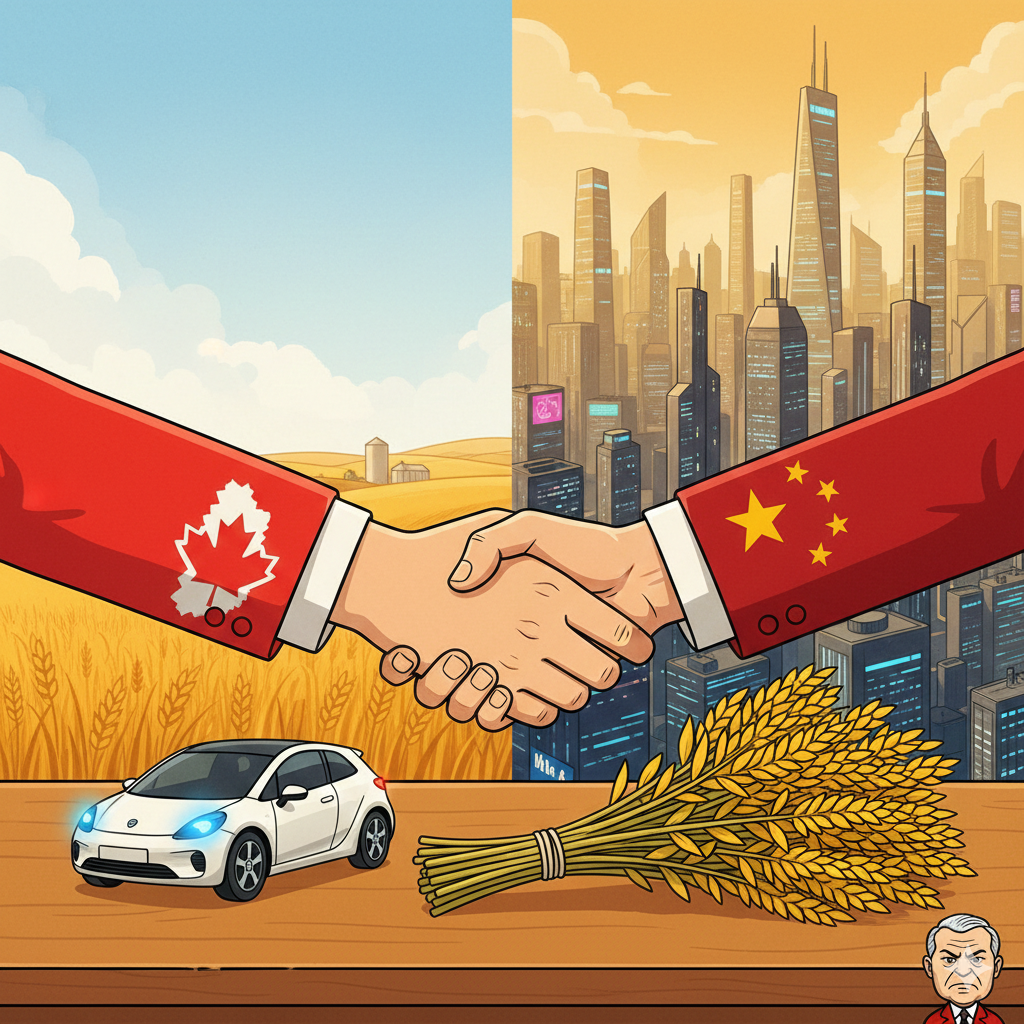
That's roughly what happened on January 16, 2026, when Canada and China struck a tariff deal that dropped the duty on Chinese electric vehicles from 100% down to 6.1%, while China cut its tariff on Canadian canola seeds from a punishing 84% to a manageable 15% [1].
Ontario's Premier Doug Ford called it a sellout. Donald Trump threatened 100% tariffs on Canada in retaliation. Prairie farmers quietly did the math and smiled. And the rest of Canada scratched its head trying to figure out whether this was trade genius or geopolitical recklessness.
The answer, like most things in economics, is: it depends on where you're standing.
The Numbers, Plain and Simple
Start with what Canada gave up and what Canada got.
What we gave: Up to 49,000 Chinese electric vehicles per year can enter Canada at a 6.1% tariff. That number rises to 70,000 over five years. By 2030, half of those vehicles must be priced under $35,000 [2].
What we got: The tariff on Canadian canola seeds going into China dropped from 84% to 15%. China also reduced duties on Canadian canola meal, lobster, crab, and peas [3].
To put those numbers in everyday terms: Canada sells roughly 2 million vehicles per year domestically [4]. Forty-nine thousand Chinese EVs represent about 2.5% of the total market. That's not a flood. It's a trickle with a cap on it.
Meanwhile, Canadian canola is a $12 billion industry. Saskatchewan and Alberta farmers export roughly $4-5 billion worth of canola annually, and China was one of the largest potential markets before it slammed the door with an 84% tariff in retaliation for Canada's arrest of Huawei executive Meng Wanzhou back in 2018 [5]. Getting that tariff down to 15% reopens a market that Prairie communities desperately need.
The lobster and crab tariff reductions matter too, particularly for Atlantic Canada. Nova Scotia and New Brunswick's fishing communities have been looking for new export markets as US trade gets choppier. China's growing middle class eats a lot of seafood [6].
Why Doug Ford Is Angry (And Why He Has a Point)
Ontario's premier didn't mince words. He said the deal gives China "a foothold in the Canadian market" at the expense of Canadian auto workers [7].
Ford's worry isn't crazy. Ontario's auto manufacturing sector employs roughly 100,000 people directly, with another 400,000 in related supply chain jobs [8]. The province has bet big on EV manufacturing, attracting billions in investment from Stellantis, Volkswagen, and Honda to build electric vehicles and battery plants in Ontario.
If Chinese EVs undercut those vehicles on price, it threatens the entire strategy. A BYD Seagull sells for around $10,000 USD in China [9]. Even with shipping, tariffs, and Canadian safety modifications, a Chinese EV priced under $35,000 would compete directly with vehicles coming off Ontario assembly lines.
The counterargument: 49,000 cars is a small number, the cap limits the damage, and affordable EVs help Canada meet its climate goals by putting electric cars within reach of people who can't afford a $60,000 Tesla.
Both arguments are valid. The deal trades a small, controlled risk to Ontario manufacturing for a large, immediate gain for Prairie agriculture and Atlantic fishing. Whether that trade-off is fair depends a lot on your postal code.
Why Trump Is Angrier (And Why That's Complicated)
Trump threatened 100% tariffs on Canada over this deal, framing it as Canada giving China backdoor access to North America [10]. His concern: Chinese goods enter Canada at low tariffs, then cross into the US through CUSMA's integrated supply chain.
Carney responded quickly, clarifying that Canada has "no intention" of pursuing a free trade agreement with China and that the deal respects CUSMA obligations [11]. The vehicle quota is specifically designed to prevent the flood scenario. And CUSMA's rules of origin mean Chinese vehicles entering Canada can't simply be re-exported to the US tariff-free. A car built in China doesn't qualify for North American free trade treatment.
But Trump's concern isn't entirely about trade mechanics. It's about loyalty. In the current geopolitical climate, any deal with China reads as choosing sides. The US wants its allies in a firm anti-China trading bloc. Canada just cut a side deal with Beijing while simultaneously asking Washington for better trade terms.
Carney is walking a tightrope between two giants. It's a familiar Canadian position, but the rope has never been this thin.
The Farmer's Perspective
Talk to a canola farmer in Moose Jaw and the China deal looks very different than it does from a Queen's Park press conference.
Canada is the world's largest canola exporter, and the crop covers roughly 22 million acres of Prairie farmland [12]. When China imposed an 84% tariff in 2019, it didn't just hurt exports. It restructured an entire industry. Farmers had to find new buyers, accept lower prices, or switch crops. Rural communities that depend on canola processing lost income. Railway shipments dropped.
Getting China's tariff down to 15% doesn't restore the old status quo. The relationship is different now, and farmers are understandably cautious about depending on a buyer who has already demonstrated a willingness to use trade as a political weapon. But 15% is workable. At that rate, Canadian canola can compete on quality and price in the Chinese market.
The value of reopened trade: roughly $2-3 billion in additional annual export potential, flowing mainly to rural Saskatchewan, Alberta, and Manitoba [13]. For communities where canola is the economic backbone, that's the difference between schools staying open and young families sticking around.
The Ethics of Trading with China
This is the part of the conversation that makes everyone uncomfortable.
China's human rights record includes well-documented concerns about Uyghur internment in Xinjiang, restrictions on Hong Kong's democratic institutions, and territorial aggression in the South China Sea [14]. Trading with China doesn't endorse those actions, but it doesn't discourage them either.
The ethical purist's position is clear: don't trade with countries that violate human rights at scale. The problem is that this principle, applied consistently, would eliminate trade with a substantial portion of the global economy. Saudi Arabia, Russia, several African and Southeast Asian nations, and arguably the United States on certain metrics would all fall outside the trading circle.
Canada chose pragmatism over purity. Canola farmers in Tisdale, Saskatchewan, need buyers. Atlantic fishers need markets. And Chinese consumers want affordable food. The moral complexity doesn't vanish because the trade deal gets signed, but neither do the livelihoods that depend on it.
The honest answer: every trade deal with an authoritarian country involves a moral compromise. The question is whether the compromise is worth the benefit, and whether there are better alternatives available. In this case, with US trade relations deteriorating and agricultural communities under pressure, the alternatives were limited.
What Happens Next
The China deal doesn't exist in isolation. It's one piece of a broader Canadian trade strategy that includes twelve deals on four continents in six months.
The immediate risk: Trump follows through on his tariff threats. If the US imposes punitive tariffs on Canada because of the China deal, the costs could quickly outweigh the benefits. Canada would be trading Chinese EV access for American market punishment, a bad exchange by any math.
The medium-term opportunity: if the deal holds, Canada establishes itself as a trading partner that maintains relationships with both the US and China. That positioning has value in a world where most countries are being forced to choose one or the other.
The long-term question: can a controlled trickle of 49,000 vehicles really stay controlled? If Chinese EVs prove wildly popular with Canadian buyers, the political pressure to raise the cap will be enormous. If they prove unreliable or unpopular, the cap won't matter. The next five years will answer that question.
The Bottom Line
The China EV deal is a textbook example of trade as trade-off. Canada gained agricultural market access worth billions for Prairie communities while accepting a limited, capped influx of affordable electric vehicles that Ontario's auto sector views as a competitive threat.
There is no version of this deal where everyone wins. Prairie farmers benefit. Atlantic fishers benefit. Canadian consumers get access to cheaper EVs. Ontario auto workers face new competition, even if it's capped. And Canada's relationship with the United States gets a little more complicated.
Carney's bet is that the gains outweigh the risks, that the caps hold, and that Canada can maintain working relationships with both Washington and Beijing without getting crushed between them.
That's a tall order for a country of 40 million people sitting between two superpowers. But then again, Canada has been managing exactly that kind of tightrope act since Confederation.
We just usually do it with more maple syrup and fewer electric cars.
References
[1] CBC News. "Canada-China EV and Agricultural Tariff Deal." January 16, 2026.
[2] NPR. "Canada China Tariffs Trump." January 24, 2026.
[3] Global Affairs Canada. "Canada-China Tariff Reduction Agreement Details." January 2026.
[4] Statistics Canada. "New Motor Vehicle Sales." Table 20-10-0001-01. 2025.
[5] Canola Council of Canada. "Canadian Canola Exports and Market Access." 2025.
[6] Fisheries and Oceans Canada. "Export Market Analysis for Atlantic Shellfish." 2025.
[7] CBC News. "Doug Ford criticizes federal China EV deal." January 2026.
[8] Ontario Ministry of Economic Development. "Automotive Sector Employment Statistics." 2025.
[9] Reuters. "BYD Seagull pricing and international market strategy." 2025.
[10] Reuters. "Trump threatens 100% tariffs on Canada over China deal." January 2026.
[11] Prime Minister of Canada. "Statement on CUSMA and China Trade." January 26, 2026.
[12] Canola Council of Canada. "Canadian Canola Industry at a Glance." 2025.
[13] Agriculture and Agri-Food Canada. "Canola Trade Projections with China Market Reopening." 2026.
[14] Human Rights Watch. "World Report 2025: China." 2025.