Published on January 25, 2026
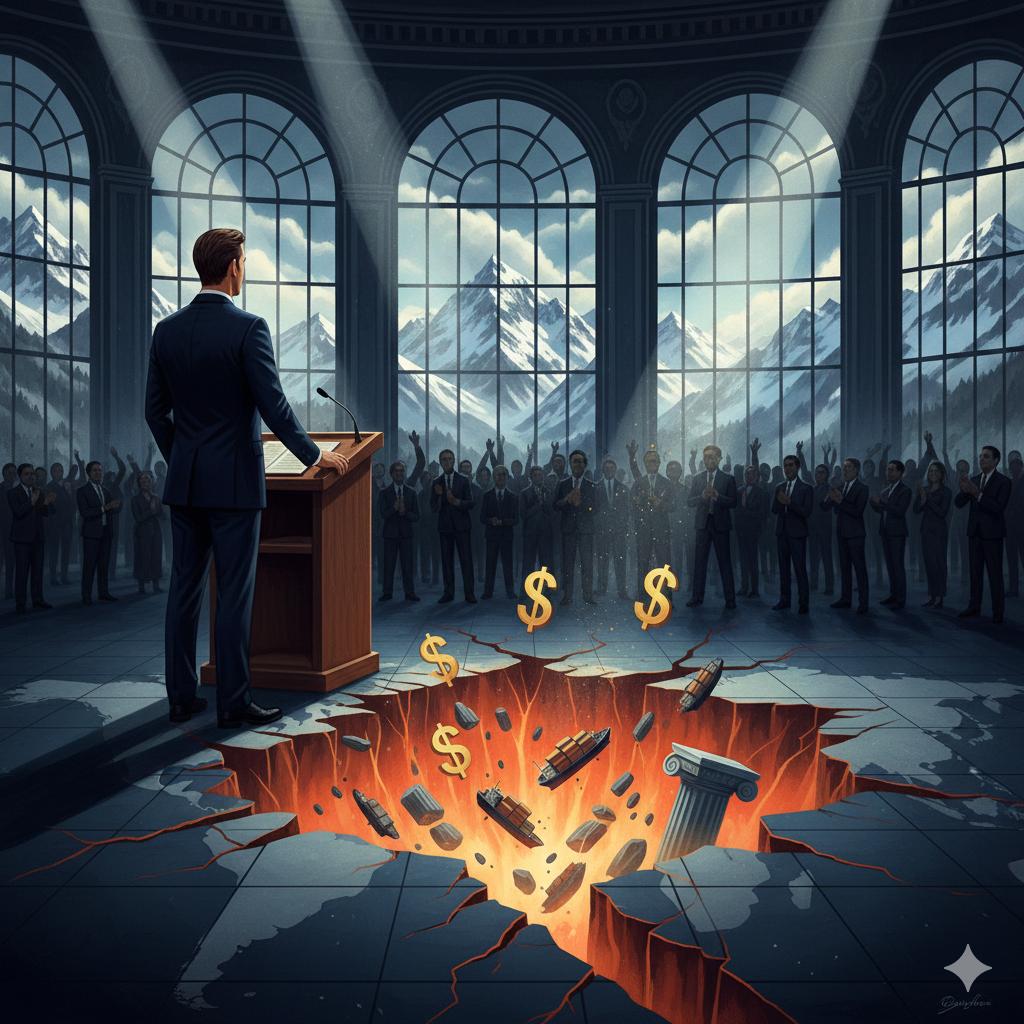
On January 20, 2026, Mark Carney stood in front of the world's richest people in Davos, Switzerland, and told them the global system they've been profiting from is broken. Then they gave him a standing ovation [1].
Think about that for a second. A room full of billionaires, hedge fund managers, and heads of state clapped enthusiastically while a Canadian told them the international order that made them wealthy is basically over. It's like a dentist telling his patients that toothbrushes don't work and getting a round of applause. Something doesn't quite add up, or everything adds up in a way that should make the rest of us pay attention.
The speech was called "Principled and Pragmatic: Canada's Path" [2]. The key line: "We are in the midst of a rupture, not a transition." Not a bumpy patch. Not an adjustment. A rupture. The kind of word you use when something is torn and won't go back together the way it was.
So what does it mean? And more importantly, does it affect the price of groceries?
What He Actually Said
Carney's argument boils down to three points, and they're worth understanding because they shape every economic decision Ottawa is making.
Point one: The rules-based international order, the system of trade agreements, international institutions, and shared norms that has governed global economics since World War Two, is no longer functioning as designed [2]. Countries are ignoring trade rules. The World Trade Organization can't enforce its decisions. Major powers are using tariffs, sanctions, and economic coercion as weapons rather than negotiating within agreed frameworks.
Point two: This isn't a temporary disruption. It's a structural change. The forces driving it, rising nationalism, great-power competition between the US and China, and declining trust in international institutions, aren't going away after one election cycle or one trade deal [2].
Point three: Middle powers like Canada need to band together and build new economic relationships that don't depend on any single great power's goodwill [2]. In plain language: stop relying on America for everything, because America isn't reliable anymore.
That's it. That's the speech. Wrapped in diplomatic language and delivered with the poise of a former central banker, but the message underneath is blunt: the old rules are gone, nobody's writing new ones, and Canada needs a plan.
What "Rupture" Means at Your Kitchen Table
Big words at fancy conferences can feel disconnected from daily life. They're not. Every shift in the global economic order shows up eventually in your bank account. It just takes time and a few steps to get there.
When the rules-based trade system works, goods flow across borders with predictable tariffs, clear regulations, and dispute resolution mechanisms that businesses can count on. That predictability keeps prices stable. A Canadian company importing electronics from South Korea knows what the tariff will be next year, so they can plan pricing, hiring, and investment.
When that system breaks down, predictability vanishes. Tariffs change with a tweet. Supply chains get rerouted based on political alliances rather than economic efficiency. Businesses add risk premiums to everything because they can't forecast costs. Those premiums become higher prices for consumers.
Canada has already felt this directly. The US tariff escalation in 2025 raised costs on everything from auto parts to construction materials [3]. Canadian exporters faced retaliatory tariffs that shrunk profit margins and forced layoffs in border communities. The Bank of Canada estimated that trade uncertainty alone shaved 0.5 to 1 percentage point off GDP growth in 2025 [4].
A sustained rupture in the global order means more of the same. Not a single shock, but a permanent increase in the cost of doing business internationally. Over time, that translates to slower wage growth, higher consumer prices, and less government revenue for the programs Canadians depend on.
The Middle Power Play
Carney's proposed solution, middle powers working together, isn't as abstract as it sounds.
A "middle power" in economics means a country that isn't big enough to set global rules on its own but is too important to ignore. Canada, Australia, South Korea, Germany, Japan, the Scandinavian countries: these are economies with advanced industries, educated populations, and stable governments that punch above their weight in trade.
Carney's argument is that if these countries align their trade policies, share supply chains, and negotiate collectively, they create a bloc large enough to maintain the benefits of open trade without depending on either the US or China to enforce the rules [2].
The combined GDP of the G7 countries (minus the US) plus Australia, South Korea, and the Nordic nations exceeds $25 trillion [5]. That's not a niche market. That's a third of the global economy.
Canada's twelve trade deals across four continents in six months are the practical expression of this theory [6]. The EU strategic partnership, the Germany critical minerals agreement, the UAE investment deal, the trade negotiations with India and ASEAN: they're all pieces of a network designed to reduce dependence on any single partner.
Whether this network can replace the stability of the old US-led order remains unproven. Building trade relationships takes years. Rerouting supply chains takes investment. And the simple fact of geography, Canada shares the world's longest undefended border with the United States, means that no amount of European deal-making fully insulates us from American economic decisions.
The Standing Ovation Problem
The Davos crowd loved the speech. That deserves a moment of honest thought about why.
The people in that room, the executives of multinational corporations, the managers of sovereign wealth funds, the leaders of countries that depend on open trade, all benefit from a world where middle powers cooperate, supply chains diversify, and trade agreements multiply. Every new trade deal creates new business opportunities. Every new bilateral relationship creates new investment markets.
Carney wasn't telling them the system is broken and suggesting they fix it. He was telling them the old system is broken and here's a new one that works for them too. That's why they clapped. It was a pitch dressed up as a diagnosis.
That doesn't mean the diagnosis is wrong. The rules-based order genuinely is under strain. American trade policy genuinely is unpredictable. Middle-power cooperation genuinely does create economic resilience. All of those things can be true while also being convenient for the people who stand to profit from the restructuring.
The question for regular Canadians isn't whether Carney's analysis is correct. It probably is. The question is who benefits most from the alternative he's proposing, and how much of that benefit flows to households versus corporations.
What the Critics Say
Conservative MP Michelle Rempel Garner challenged Carney to move past "fractured geopolitics" rhetoric and deliver concrete results for Canadians struggling with the cost of living [7]. That's a fair criticism. Davos speeches don't reduce grocery bills.
Other critics disputed Carney's claim that the rules-based order is effectively a "fiction" [7]. Their argument: the system is under pressure but still functioning. The WTO still processes disputes. Trade agreements still exist. International institutions still coordinate policy. Declaring the system dead could become a self-fulfilling prophecy, giving countries permission to abandon rules they've merely been bending.
There's also a historical concern. The last time the international economic order truly ruptured, in the 1930s, countries responded with exactly the kind of bilateral deal-making and bloc formation that Carney is now proposing. The result was not stability. It was a fragmented global economy that contributed to the conditions for World War Two [8].
Carney would argue the analogy is imperfect because today's middle powers are democracies with aligned values, not competing empires. He's right that it's different. Whether it's different enough is an open question.
What It Means Going Forward
If Carney is right about the rupture, Canada's economic future looks fundamentally different from its economic past.
For the last 80 years, Canadian prosperity has rested on two pillars: abundant natural resources and privileged access to the American market. The US bought our oil, our lumber, our auto parts, and our minerals. In return, we got cheap consumer goods, technology, and the security umbrella of the world's largest military. It wasn't a perfect arrangement, but it was a stable one.
A rupture in that arrangement means Canada needs new pillars. That's what the European pivot, the UAE deal, the Asian trade negotiations, and the critical minerals alliance are all about: building economic foundations that don't collapse if one trading partner becomes hostile.
For Canadian workers, this means new opportunities in sectors aligned with trade diversification: critical minerals, clean energy, defence manufacturing, and agricultural exports to new markets. It also means disruption for sectors that depend on US integration, particularly auto manufacturing and energy exports.
For Canadian households, it means a period of adjustment where the cost of economic restructuring shows up in prices, taxes, and government spending priorities. Building new trade infrastructure isn't free. The benefits are real but they're medium-term. The costs are immediate.
The Bottom Line
Carney's Davos speech was the most significant Canadian foreign policy statement in years, and it landed not because it was optimistic but because it was honest. The old system isn't working. Pretending otherwise doesn't change that reality.
The question is whether Canada's alternative, a network of middle-power trade relationships backed by strategic resource partnerships, can actually deliver the economic stability that the old US-centred order provided. It's a reasonable theory supported by early results: twelve deals in six months is impressive execution, even if the long-term outcomes remain uncertain.
For the average Canadian, the speech means that the economic ground is shifting under everyone's feet. The familiar patterns of trade, employment, and price stability that defined the last few decades are being reorganized. That's unsettling. It's also, potentially, an opportunity for a country with Canada's resources, geography, and talent to build something more resilient than what came before.
Or it's a very expensive bet on a theory that hasn't been tested at scale.
Either way, the billionaires in Davos seemed to like it. Take from that what you will.
References
[1] Reuters. "Carney receives standing ovation at World Economic Forum." January 20, 2026.
[2] Prime Minister of Canada. "Principled and Pragmatic: Canada's Path." Davos, January 20, 2026.
[3] Bank of Canada. "Monetary Policy Report." October 2025.
[4] Bank of Canada. "Trade Uncertainty and Canadian Economic Growth." Staff Analytical Note. 2025.
[5] IMF. "World Economic Outlook Database." October 2025.
[6] Global Affairs Canada. "Trade and Investment Agreements Summary." 2025-2026.
[7] CBC News. "Critics challenge Carney's Davos speech on rules-based order." January 2026.
[8] Kindleberger, Charles P. "The World in Depression, 1929-1939." University of California Press. 1973.