Published on February 7, 2026
Last March, I wrote a detailed breakdown of Canada's carbon tax, walking through the actual numbers, the rebates, and the economic evidence showing that 80% of households came out ahead financially. I concluded that it was "good policy and difficult politics."
Well, Mark Carney just proved the second half of that statement right by killing the first half entirely.
The man who spent years as the UN Special Envoy on Climate Action and Finance, who chaired the Financial Stability Board's Task Force on Climate-related Financial Disclosures, who literally wrote the framework that global banks use to assess climate risk, that guy eliminated the consumer carbon tax, scrapped the proposed emissions cap for oil and gas, and signed a deal to build a new pipeline from Alberta to the British Columbia coast.
If you're experiencing cognitive whiplash right now, you're not alone.
What Actually Changed
Three things happened in rapid succession that collectively represent the most significant climate policy reversal in Canadian history.
April 2025: The consumer-facing carbon tax on fuels was eliminated [1]. Gone. No more 17.6 cents per litre at the pump. No more quarterly rebate cheques. The entire mechanism that I spent 2,000 words explaining last year, the one that the Parliamentary Budget Officer confirmed benefited 80% of households, simply ceased to exist.
November 2025: The proposed emissions cap for the oil and gas sector was suspended [2]. This was the regulatory backstop that environmental groups had fought for years to establish, the mechanism that would have set declining limits on the sector responsible for 28% of Canada's greenhouse gas emissions. Suspended indefinitely, which in government language usually means abandoned.
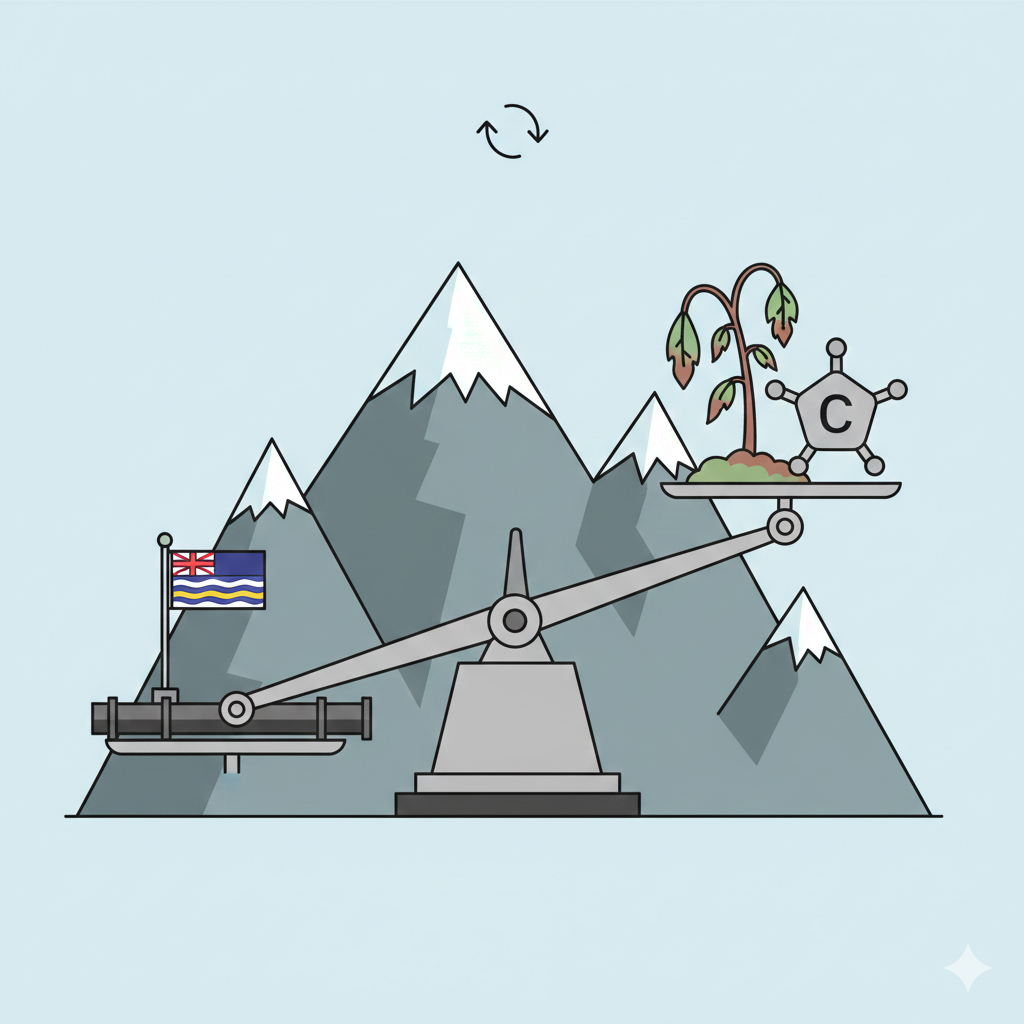
November 2025: Carney signed a Memorandum of Understanding with Alberta Premier Danielle Smith to build a new oil pipeline from Alberta to the BC coast, capable of transporting one million barrels per day to access Asian markets [3]. The project is explicitly exempt from climate legislation, including the greenhouse gas emissions cap. In exchange, Alberta committed to strengthen industrial carbon pricing and support a carbon capture and storage project.
That last detail, the exemption from climate legislation, is the part that made the Green Party's Elizabeth May call it "a significant betrayal and a reversal" [4]. It's also the part that makes the economic analysis genuinely complicated.
The Political Math
To understand why Carney did this, you have to understand the electoral math he faced.
Carney won a minority government with 169 seats in April 2025, three seats short of a majority [5]. He needed to hold together a coalition that included urban progressives who care deeply about climate action and suburban-to-rural voters in Ontario, Alberta, and British Columbia who experienced the carbon tax primarily as a price increase at the gas pump.
The carbon tax was polling as the single most unpopular federal policy in the country. Not because of its economic impact, which was modest, but because of its visibility. Every trip to the gas station reminded voters of a government-imposed cost. The rebate cheques, arriving quarterly, were too infrequent and too abstract to offset the psychological irritation of watching the pump total climb.
Economists had been saying for years that a revenue-neutral carbon price was the most efficient tool for reducing emissions. Voters had been saying, with increasing volume, that they didn't care about efficiency. They wanted the price to stop going up.
Carney chose the voters. You can argue whether that was principled leadership or cynical calculation, but the political reality was straightforward: no minority government survives by dying on a hill its voters have already abandoned.
What We Lost (By the Numbers)
The carbon tax wasn't perfect, but it was doing measurable work.
Environment and Climate Change Canada estimated that federal carbon pricing would reduce emissions by 60-80 megatonnes annually by 2030, representing roughly 8-11% of Canada's total greenhouse gas emissions [6]. That's not transformative, but it's significant. Replacing that reduction through other mechanisms, regulation, subsidies, technology mandates, is both more expensive and less certain.
The C.D. Howe Institute's analysis showed carbon pricing achieved emission reductions at roughly one-third the cost of equivalent regulatory approaches [7]. By eliminating the carbon price and relying on alternative policies, Canada is choosing a more expensive path to the same destination. Or, more likely, a more expensive path to a different, less ambitious destination.
Statistics Canada data showed that 67% of surveyed businesses had improved energy efficiency in response to carbon pricing, 43% had switched to lower-carbon energy sources, and 31% had invested in clean technology [8]. Those incentives didn't disappear when the tax was removed, companies that already invested won't un-invest, but the signal for future behaviour is gone.
The fiscal impact is also worth noting. Carbon tax revenue, all of which was returned through rebates, amounted to roughly $8-10 billion annually. Those rebate cheques, which disproportionately benefited lower-income households, stopped arriving. For a family of four in Ontario that was receiving $1,056 annually in carbon rebates against $739 in costs, that's a net loss of $317 per year [9].
The carbon tax elimination saved households money at the pump while removing a progressive income transfer that helped the bottom 60% of earners. Whether that trade-off is positive or negative depends entirely on your income bracket.
The Pipeline Deal: Economics vs. Emissions
The Alberta pipeline deal is where the economic analysis gets genuinely interesting, because unlike the carbon tax, which was relatively straightforward to evaluate, the pipeline involves trade-offs that stretch across decades.
The case for the pipeline: Canada is the world's fourth-largest oil producer, and much of our crude sells at a steep discount to global benchmarks because we lack sufficient pipeline capacity to reach markets beyond the United States [10]. The Western Canadian Select discount has historically run $10-20 per barrel below West Texas Intermediate. On production of roughly 5 million barrels per day, that discount costs the Canadian economy $18-36 billion annually in foregone revenue.
A new pipeline to the Pacific coast, carrying one million barrels per day to Asian markets, would allow Canadian producers to access global pricing. Even a partial closing of the discount gap would generate billions in additional revenue, royalties, and tax income. Alberta's treasury, the federal government, and producing companies all benefit substantially.
The case against: a new pipeline locks in fossil fuel infrastructure for 30-40 years, directly contradicting Canada's stated climate targets. Carney himself acknowledged that Canada will miss its 2030 and 2035 emission targets [11]. Building a million-barrel-per-day pipeline while missing emission targets isn't just a contradiction. It's a policy statement about which priority actually wins when they conflict.
The Alberta trade-off, stronger industrial carbon pricing and a carbon capture project in exchange for the pipeline exemption from climate legislation, sounds like a balanced compromise. In practice, carbon capture and storage remains unproven at scale and has a track record of over-promising and under-delivering. The Boundary Dam CCS project in Saskatchewan, Canada's highest-profile attempt, captured roughly 40% of its target emissions while costing significantly more than projected [12].
The International Optics
There's a layer of irony here that deserves acknowledgment. Carney spent years building the global framework for climate-related financial disclosures. His work influenced how trillions of dollars in institutional capital assess climate risk. Banks, pension funds, and insurance companies around the world use standards he helped create.
Now those same institutions are reading headlines about the Canadian Prime Minister exempting a major oil pipeline from climate legislation and scrapping clean electricity rules as part of the deal. The Walrus published a piece titled "No Matter Which Way You Look at It, Carney Has Abandoned Climate" [13]. Al Jazeera covered the rollback under "Canada rolls back climate rules to boost investments" [14].
Whether this damages Canada's credibility on climate finance is debatable. Carney would argue that pragmatic energy policy and climate finance standards serve different functions, that you can build infrastructure while improving disclosure frameworks. Critics would argue that building exempt pipelines while chairing climate finance initiatives is the kind of contradiction that makes the entire system feel performative.
The most charitable interpretation: Carney calculated that Canada's emissions trajectory was going to miss targets regardless, that the pipeline revenue would fund transition investments over time, and that industrial carbon pricing on Alberta's heavy emitters would do more than a consumer carbon tax that was politically unsustainable.
The least charitable interpretation: the carbon tax was sacrificed for votes, and the pipeline was the price of Alberta's cooperation.
The truth, as usual, probably lives somewhere in the uncomfortable middle.
What Replaces the Carbon Price?
This is the question that hasn't been adequately answered. If you eliminate the most efficient mechanism for reducing emissions, what fills the gap?
The government has pointed to several alternatives: industrial carbon pricing on large emitters (which Alberta is strengthening under the pipeline deal), investment tax credits for clean technology, regulation on specific sectors, and the $2 billion investment in carbon capture.
The problem with regulatory approaches is cost. The C.D. Howe analysis estimated that regulations achieve comparable emission reductions at roughly three times the cost of carbon pricing [7]. That cost doesn't appear on your gas receipt, but it shows up in higher consumer prices, reduced economic efficiency, and government spending that could have gone elsewhere.
Clean technology investment credits are useful but targeted. They accelerate adoption among companies already inclined to invest in green technology. They don't create the broad-based incentive that a carbon price provides to every business and household to reduce their carbon footprint.
The honest assessment: Canada's emissions trajectory just got worse. By how much depends on implementation details that won't be clear for years. The government is betting on technology solutions, particularly carbon capture, that haven't proven they can operate at the scale required.
The Bottom Line
The carbon tax reversal is the clearest example of the tension at the heart of Carney's premiership. He's a technically sophisticated leader who understands exactly what the evidence says about carbon pricing, and he chose political survival over policy optimization.
That choice has real consequences. The Progressive transfer mechanism that helped lower-income households is gone. The broad-based price signal that was driving business investment in efficiency is gone. The cheapest pathway to emission reductions has been replaced by more expensive alternatives.
What Canada got in return: political stability for a minority government, a pipeline that could generate billions in revenue, and a working relationship with Alberta that has eluded federal governments for a generation.
Whether that trade was worth it depends on your time horizon. In the short term, gas prices are lower and the political temperature has dropped. In the long term, the emissions bill is coming due, and we just threw away our most cost-effective tool for paying it.
When I wrote about the carbon tax last year, I said the economic reality was "more nuanced and less dramatic than most political debates suggest." That's still true. What's changed is that the nuance now includes a former climate finance architect building an exempt pipeline, and a country that's officially chosen economic pragmatism over environmental ambition.
The planet, as always, doesn't vote.
References
[1] Prime Minister of Canada. "Consumer Carbon Price Elimination." April 2025.
[2] Environment and Climate Change Canada. "Emissions Cap Regulatory Status Update." November 2025.
[3] Prime Minister of Canada. "Alberta Pipeline Memorandum of Understanding." November 2025.
[4] CBC News. "Elizabeth May calls pipeline deal 'significant betrayal.'" November 2025.
[5] Elections Canada. "43rd General Election Official Results." April 28, 2025.
[6] Environment and Climate Change Canada. "Projected Emissions Reductions from Carbon Pricing." 2024.
[7] C.D. Howe Institute. "The Costs and Benefits of Carbon Pricing in Canada." Commentary 618. 2023.
[8] Statistics Canada. "Business Response to Carbon Pricing Policies." Table 27-10-0015-01. 2024.
[9] Parliamentary Budget Officer. "Distributional Analysis of Federal Carbon Pricing." 2024.
[10] Natural Resources Canada. "Crude Oil Production and Pipeline Capacity." 2025.
[11] Prime Minister of Canada. "Statement on Climate Targets." November 2025.
[12] International CCS Knowledge Centre. "Boundary Dam Project Performance Review." 2024.
[13] The Walrus. "No Matter Which Way You Look at It, Carney Has Abandoned Climate." November 2025.
[14] Al Jazeera. "Canada rolls back climate rules to boost investments." November 27, 2025.