Published on March 10, 2025
Ever wonder why politicians get so heated about a policy that costs most families less than their monthly Netflix subscription? Or why something called a "revenue-neutral tax" generates more controversy than a playoff overtime goal?
Welcome to Canada's carbon tax, probably the most misunderstood policy in recent Canadian history, where the actual economic impact bears little resemblance to the political rhetoric surrounding it.
What You Actually Pay
As of 2024, the carbon tax adds $65 per tonne of CO2 emissions¹. This translates to approximately 11 cents per litre of gasoline, 13 cents per litre of diesel fuel, and varies for other fossil fuels based on their carbon content².
For the average Canadian household, Environment and Climate Change Canada estimates the direct cost of federal carbon pricing at approximately $400-$600 annually³. This includes gasoline, heating fuel, and indirect costs from businesses passing carbon costs through to consumers.
At the gas pump, the breakdown looks like this. In Toronto, current gasoline prices include about 95 cents per litre for base gasoline, 10 cents federal excise tax, 14.7 cents provincial fuel tax, HST on top, and 11 cents carbon tax⁵. For someone filling a 50-litre tank monthly, the carbon tax adds $5.50 per fill-up, or $66 annually.
Carbon tax impacts vary significantly across Canada. Alberta households face higher carbon costs due to greater reliance on fossil fuels for electricity and heating, but also receive larger rebates. Quebec households face lower direct costs because the province uses cap-and-trade instead of the federal carbon tax and has abundant hydroelectric power⁷. Atlantic Canada shows mixed results depending on heating fuel choices.
What You Get Back
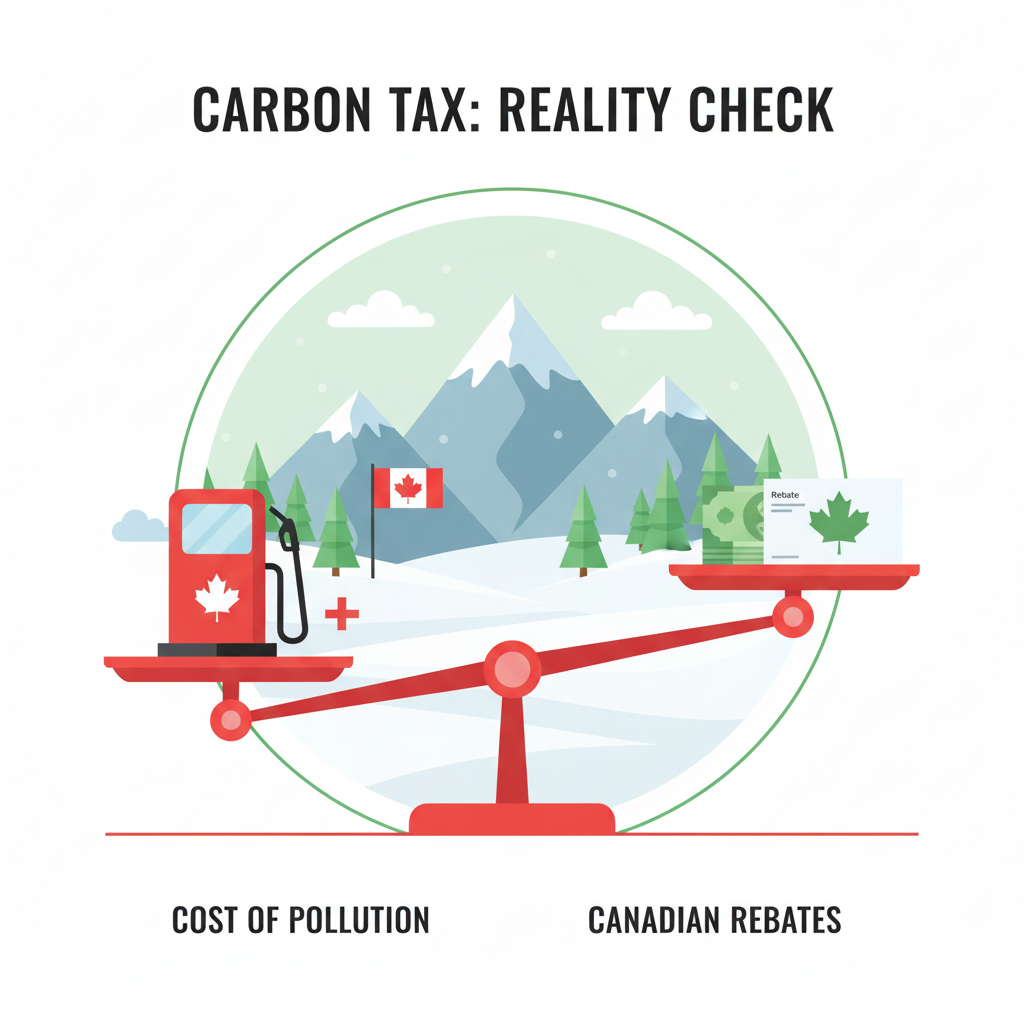
The federal government returns all carbon tax revenue to provinces, either through provincial carbon pricing systems or direct rebates to residents. In provinces using the federal system, most households receive more in rebates than they pay in carbon tax.
According to the Parliamentary Budget Officer's 2024 analysis⁴, a family of four in Ontario receives $1,056 annually in carbon rebates while paying approximately $739 in direct and indirect carbon costs, for a net benefit of $317 annually. In Saskatchewan, the same family receives $1,504 in rebates against $1,051 in costs, netting $453 annually.
The reason most families come out ahead is simple: carbon pricing revenue gets distributed equally per household, but carbon consumption correlates with income. Wealthier households tend to drive more, heat larger homes, and consume more carbon-intensive goods and services.
The Canadian Climate Institute found that households in the bottom income quintile receive net benefits of $300-$600 annually, while the top quintile typically pays net costs of $200-$400¹⁴. The Parliamentary Budget Officer concluded that 80% of households receive more in rebates than they pay in carbon costs¹⁵.
Business and the Economy
Businesses face carbon pricing differently than households. Companies pay carbon tax on their fossil fuel consumption but don't receive direct rebates. Instead, they face incentives to reduce emissions or pass costs to consumers.
According to Statistics Canada, businesses have responded by improving energy efficiency (67% of surveyed companies), switching to lower-carbon energy sources (43%), adjusting pricing to reflect carbon costs (39%), and investing in clean technology (31%)⁶.
From an economic perspective, carbon pricing is considered one of the most efficient ways to reduce greenhouse gas emissions. The C.D. Howe Institute's 2023 analysis found that carbon pricing achieves emission reductions at roughly one-third the cost of equivalent regulatory approaches⁸.
One frequent criticism involves "carbon leakage," the concern that carbon pricing drives economic activity to jurisdictions without carbon pricing. Environment and Climate Change Canada's 2024 competitiveness analysis found limited evidence of significant carbon leakage in most sectors¹². The federal government has responded with output-based pricing for large industrial emitters, which provides partial protection for trade-exposed industries while maintaining incentives for emission reductions¹³.
Canada's carbon tax isn't unique globally. According to the World Bank, 46 countries and 36 subnational jurisdictions have implemented or scheduled carbon pricing initiatives⁹. Canada's $65 per tonne sits in the middle range internationally.
Does It Actually Work?
During 2022-2023's inflation surge, carbon tax increases received blame for rising costs. Statistics Canada data shows that carbon pricing contributed approximately 0.15 percentage points to headline inflation¹⁷, meaningful but not the primary driver of price increases. During periods when inflation reached 6-8%, carbon pricing explained roughly 2% of the total increase.
University of Calgary economists found minimal macroeconomic impacts from carbon pricing, with GDP effects of less than 0.1% annually¹⁶. These findings suggest that while carbon pricing creates costs for some households and businesses, the overall economic impact is modest compared to the policy's political prominence.
Carbon pricing's economic logic relies on long-term incentive effects rather than immediate dramatic changes. The price signal encourages gradual shifts toward lower-carbon alternatives as they become available and cost-competitive. Electric vehicle adoption provides an example: carbon pricing makes gasoline more expensive, improving the relative economics of electric vehicles.
The Bottom Line
Canada's carbon tax represents a classic case of policy design conflicting with political messaging. The actual economic impact on most households is modest and often positive, while the political heat generates temperature readings off the charts.
For the majority of Canadian families, carbon pricing functions as a progressive income transfer that happens to create incentives for emission reductions. You pay a bit more for gas and heating, but receive more back through quarterly rebates.
The policy's economic efficiency makes it attractive to economists and policy analysts. Its visibility at gas pumps makes it politically challenging. This disconnect explains why carbon pricing can simultaneously be good policy and difficult politics.
The next time someone complains about carbon tax costs, remind them to check their bank account for those quarterly rebate deposits. For most Canadians, the carbon tax debate involves arguing about a policy that puts more money in their pocket than it takes out.
Whether you support or oppose carbon pricing, the economic reality is more nuanced and less dramatic than most political debates suggest. In the end, carbon pricing represents a relatively efficient, low-cost approach to emission reductions that most households navigate without significant economic hardship.
References
[1] Environment and Climate Change Canada. "Federal carbon pollution pricing system." 2024.
[2] Environment and Climate Change Canada. "How carbon pollution pricing reduces emissions." 2024.
[3] Environment and Climate Change Canada. "Household impacts of federal carbon pollution pricing." 2024.
[4] Parliamentary Budget Officer. "Distributional Analysis of Federal Carbon Pricing." 2024.
[5] Natural Resources Canada. "Fuel pricing information." 2024.
[6] Statistics Canada. "Business response to carbon pricing policies." Table 27-10-0015-01. 2024.
[7] Environment and Climate Change Canada. "Climate Action Incentive Payment amounts for 2024-25." 2024.
[8] C.D. Howe Institute. "The Costs and Benefits of Carbon Pricing in Canada." Commentary 618. 2023.
[9] World Bank. "State and Trends of Carbon Pricing 2024." 2024.
[12] Environment and Climate Change Canada. "Competitiveness impacts of carbon pricing." 2024.
[13] Environment and Climate Change Canada. "Output-based pricing system for industry." 2024.
[14] Canadian Climate Institute. "Canada's Carbon Pricing Systems: Economic and Distributional Impacts." 2023.
[15] Parliamentary Budget Officer. "Federal Carbon Pricing Impact on Households: Update." 2023.
[16] University of Calgary School of Public Policy. "Macroeconomic Impacts of Federal Carbon Pricing." 2023.
[17] Statistics Canada. "Contribution of carbon pricing to Consumer Price Index inflation." 2024.