Published on November 1, 2025
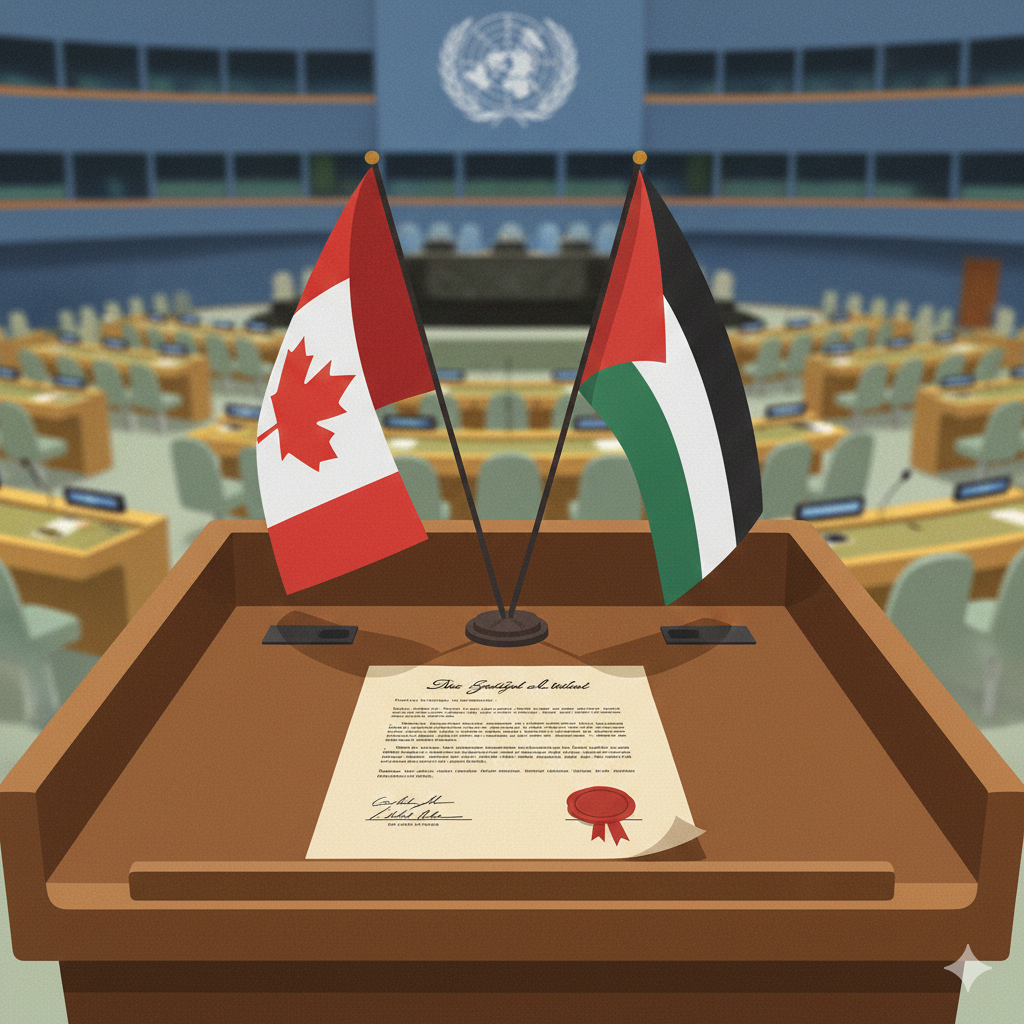
On September 21, 2025, Canada became the first G7 nation to formally recognize the State of Palestine [1]. The UK, Australia, and Portugal did the same that week, but Canada went first. Along with the recognition came over $400 million in funding for the West Bank and Gaza, including $47 million for judicial systems, governance, economic resilience, and democratization [2].
This isn't an economics blog that pretends foreign policy is simple. It's an economics blog that asks how much things cost and who pays.
Palestine recognition is a values-based decision with economic implications. Let's map both.
What Recognition Actually Means
Recognizing a state in international law means acknowledging it as a sovereign entity with defined territory, a permanent population, a government, and the capacity to enter relations with other states [3]. In practical terms, it opens the door to diplomatic representation, bilateral agreements, and formal channels of communication.
What it doesn't do: create borders, end the conflict, or solve the humanitarian crisis in Gaza. Recognition is a political and legal statement. It's the diplomatic equivalent of saying "you exist and we acknowledge your right to exist." Important symbolically. Limited practically.
Canada's recognition doesn't change the territorial status quo. Israeli settlements in the West Bank remain. The blockade dynamics in Gaza remain. The fundamental disagreements between Israeli and Palestinian leadership remain. What changes is Canada's formal diplomatic posture and the signal it sends to other countries.
The $400 Million
The funding package breaks down across several categories [2].
Humanitarian aid for Gaza addresses immediate crisis needs: food, medical supplies, shelter, and essential services for a population that has experienced devastating destruction.
The $47 million for governance and judicial systems is an investment in Palestinian institutional capacity, the kind of state-building infrastructure that would be needed if a two-state solution ever materializes.
Economic resilience funding supports businesses, agricultural production, and employment in the West Bank and Gaza.
As a percentage of Canada's foreign aid budget (roughly $8 billion annually), $400 million is significant but not transformative [4]. It represents about 5% of annual aid spending, concentrated in a single region. Whether it produces lasting results depends on conditions on the ground that Canada has limited ability to influence.
The Economic Consequences of Taking a Position
Foreign policy decisions have trade implications. They always do.
Canada's trade with Israel is modest: roughly $2 billion annually in two-way merchandise trade [5]. Canada-Israel Free Trade Agreement (CIFTA) has been in effect since 1997. Palestine recognition could create diplomatic friction that affects that relationship, though Israel's government has tools to express displeasure short of cancelling trade agreements.
Canada's trade with Arab and Muslim-majority countries is larger in aggregate: the UAE alone represents the $70 billion investment deal discussed elsewhere in this blog. Saudi Arabia, Qatar, Indonesia, Malaysia, Turkey, and Pakistan collectively represent substantial trade and investment relationships.
Palestine recognition signals alignment with positions held by virtually every Arab and Muslim-majority country. In a year when Canada is actively courting those markets for trade diversification, the timing is not coincidental. The diplomatic goodwill generated by recognition creates a more favourable environment for economic negotiations across the Middle East, North Africa, and Southeast Asia.
This isn't to say the decision was purely transactional. Canada's Liberal government has long expressed support for Palestinian self-determination. But the economic backdrop matters. Recognizing Palestine costs relatively little in trade terms (modest Israel relationship) while potentially benefiting much larger economic relationships across the developing world.
The Diplomatic Capital Question
Every foreign policy decision spends or earns diplomatic capital, the informal currency of international relationships that influences everything from trade negotiations to votes at the United Nations.
Recognition earns capital with: the 139 countries that already recognize Palestine (out of 193 UN member states) [6], the Arab League, the Organisation of Islamic Cooperation, the African Union, and most of the Global South. These are countries and institutions that Canada is actively engaging through its trade diversification strategy.
Recognition spends capital with: Israel (significant), the United States under the current administration (notable), and domestic constituencies that support Israel (real but manageable in Canadian politics).
The math is straightforward: recognizing Palestine aligns Canada with the global majority while creating friction with two countries, one of which is already imposing tariffs on Canadian goods. The diplomatic return on investment is positive by the numbers, even if the decision generates heated debate domestically.
The Ethics, Simply
The ethical arguments for recognition: Palestinians have a right to self-determination under international law. A two-state solution, which Canada officially supports, requires acknowledging the existence of both states. The humanitarian situation in Gaza demands international engagement that formal recognition facilitates.
The ethical arguments against: recognition could be seen as rewarding Hamas governance in Gaza, which Canada designates as a terrorist organization. The timing, during an active conflict, could undermine leverage that conditional recognition might provide. And recognition without meaningful enforcement of Palestinian rights amounts to a symbolic gesture that doesn't change material conditions.
Both sets of arguments have merit. The government chose to act, and the debate will continue. What's worth noting is that economic analysis can describe the costs and benefits but can't resolve the underlying moral question, which is ultimately about what kind of country Canada wants to be in the world.
The Bottom Line
Canada's recognition of Palestine is a foreign policy decision with modest direct economic costs and potentially meaningful indirect economic benefits. The trade relationship with Israel is small enough that any friction is manageable. The signal to Arab and Muslim-majority countries, where Canada is actively pursuing trade diversification, strengthens those relationships.
The $400 million in aid is a serious commitment that reflects genuine concern for humanitarian conditions, though its impact depends on ground realities that Canada can't control.
For Canadian taxpayers, the fiscal cost is a fraction of the foreign aid budget. For Canadian businesses operating in the Middle East, the diplomatic environment just got slightly more favourable. For the broader question of Canadian foreign policy identity, the decision represents a choice to align with international majority opinion at the cost of friction with traditional allies.
Whether that trade-off serves Canada's long-term interests depends on whether the middle-power strategy Carney is building actually produces the diversified, multilateral world he described at Davos. If it does, early moves like Palestine recognition look prescient. If the old order reasserts itself, they look premature.
Time will tell. Economics will keep score.
References
[1] Prime Minister of Canada. "Statement on Canada's Recognition of the State of Palestine." September 21, 2025.
[2] Global Affairs Canada. "Canada's Funding Commitments to Palestine." September 2025.
[3] Montevideo Convention on the Rights and Duties of States. 1933.
[4] Global Affairs Canada. "International Assistance Budget." 2025-2026.
[5] Statistics Canada. "Canada-Israel Bilateral Trade." 2025.
[6] United Nations. "Status of Palestine in the United Nations." 2025.