Published on March 15, 2026
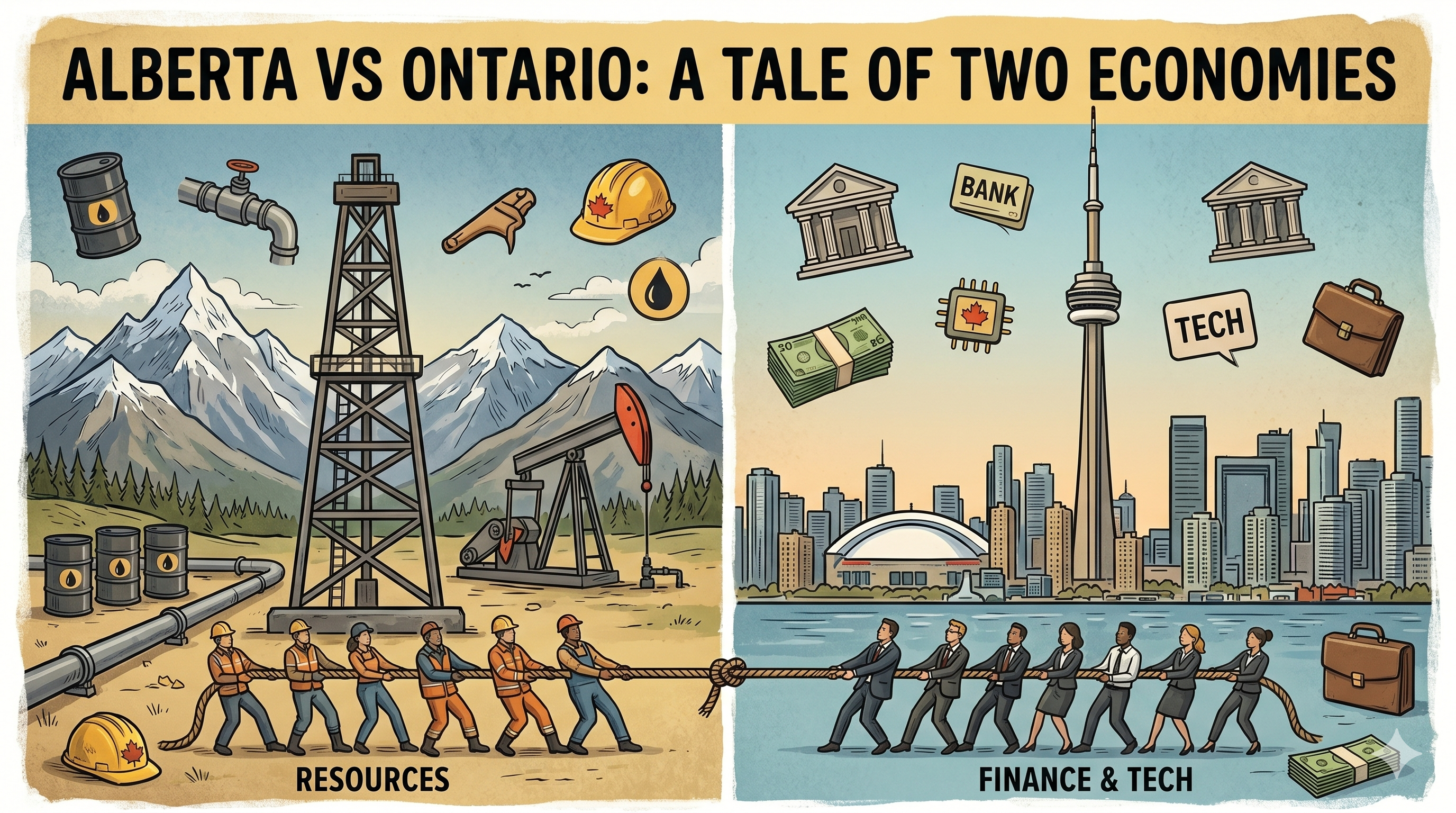
If Canada were a family, Alberta and Ontario would be the two siblings who can't stop arguing at Thanksgiving dinner. One made a fortune in the oil patch and won't let anyone forget it. The other quietly runs the family business and thinks that entitles them to the head of the table. Both are convinced they carry the rest of the family on their backs. Both are at least partially right.
Together, these two provinces account for roughly 55% of Canada's GDP [1]. Understanding how their economies work — and why they clash — tells you more about the Canadian economy than any textbook ever could.
By the Numbers
Start with raw economic output. Ontario generates roughly $940 billion in GDP annually, making it the largest provincial economy by a wide margin [1]. Alberta comes in second at approximately $400 billion [1]. Ontario wins on total size, which makes sense given it has nearly four times the population.
But flip the lens to GDP per capita, and the picture reverses completely. Alberta's GDP per capita sits around $82,000, consistently the highest of any province and roughly 30% above the national average [2]. Ontario's GDP per capita hovers around $60,000 — respectable, but below the national average [2]. An Albertan, on a per-person basis, produces significantly more economic output than an Ontarian.
Why? Three words: oil and gas. Alberta's energy sector accounts for roughly 25% of its provincial GDP [3]. When oil prices are high, Alberta's economy roars. When they crash — as they did in 2015 and again in 2020 — the province feels it deeply. Ontario's economy is far more diversified: manufacturing contributes about 12%, financial services around 10%, real estate another 14%, and a growing technology sector adds to the mix [4].
Think of it this way. Alberta is the friend who went all-in on a single stock and happened to pick a winner. Ontario is the friend with the balanced portfolio. Both strategies have their merits. Both have their risks.
The Equalization Question
Nothing generates more heat between these two provinces than equalization payments. And nothing is more consistently misunderstood.
Between 2000 and 2025, Alberta contributed an estimated net fiscal transfer of over $240 billion more to the federal government than it received back in services and transfers [5]. That number is staggering, and Albertans are right to feel the weight of it. Over the same period, Ontario shifted from being a consistent net contributor to occasionally qualifying for equalization payments itself — a development that would have seemed unthinkable twenty years ago [6].
The resentment from Alberta is understandable. Imagine paying significantly more into a shared household account than you ever get back, year after year, while watching other provinces benefit from programs funded partly by your contributions. The frustration is real, and it's backed by data.
But the mechanics deserve closer examination. Equalization doesn't take money from Alberta and hand it to Quebec or anyone else. The federal government collects taxes from individuals and businesses across the country and then distributes transfers based on a formula tied to provincial fiscal capacity [7]. Alberta pays more because Albertans earn more. That's how progressive taxation works — not a conspiracy, just math.
Ontario's position is more complicated. The province qualified for equalization payments starting in 2009, receiving roughly $3.9 billion at its peak in 2018-19 [6]. For a province that had historically been a net contributor, this was a humbling development that reflected real structural challenges in Ontario's manufacturing sector following the 2008 financial crisis and the decline of the auto industry.
Energy Versus Everything Else
Alberta's oil sands represent one of the largest petroleum reserves on the planet, with proven reserves of approximately 165 billion barrels [8]. The energy sector directly employs about 150,000 Albertans and indirectly supports hundreds of thousands more [3]. Average wages in Alberta's mining, quarrying, and oil and gas extraction sector exceed $120,000 annually [9] — roughly double the national average across all industries.
Ontario's economic engine runs on diversity. The province is home to Canada's financial capital in Toronto, where the banking and insurance sectors employ over 400,000 people [10]. The Greater Toronto Area hosts a technology sector that has grown rapidly, with Toronto ranking among the top North American tech talent markets [11]. Ontario's manufacturing sector, while diminished from its peak, still produces everything from automobiles to processed food to aerospace components, contributing roughly $90 billion annually to GDP [4].
The vulnerability profiles differ dramatically. When oil prices collapsed from over $100 per barrel in mid-2014 to under $30 in early 2016, Alberta's economy contracted by 3.7% in a single year [12]. Unemployment in Calgary nearly doubled. Meanwhile, Ontario barely felt the ripple — in fact, the lower energy costs provided a modest boost to manufacturers.
Conversely, when trade disruptions hit manufacturing supply chains, Ontario absorbs the damage while Alberta carries on largely unaffected. The 2024-2025 tariff tensions with the United States threatened Ontario's auto sector far more directly than Alberta's energy exports [13].
Where Your Paycheque Goes Further
You might assume that Alberta's higher incomes translate to a higher cost of living. In some ways, they do — but not where it matters most.
The median household income in Alberta is approximately $104,000, compared to roughly $91,000 in Ontario [14]. Alberta also has no provincial sales tax, meaning every purchase is immediately cheaper than in Ontario, where the HST adds 13% to most goods and services [15]. Alberta's flat provincial income tax rate of 10% on the first $148,269 compares favourably to Ontario's graduated rates that reach 11.16% at incomes above $150,000 [16].
But the biggest gap? Housing. According to the Canada Mortgage and Housing Corporation, the average home price in the Calgary metropolitan area was approximately $535,000 in early 2026 [17]. In the Greater Toronto Area, the average sits around $1,050,000 [17]. A household earning the median income in Calgary can realistically afford an average home. A household earning the median income in Toronto cannot come close.
Rent tells a similar story. Average two-bedroom rental rates in Calgary run around $1,800 per month, while the same apartment in Toronto costs roughly $2,900 [18]. A young couple starting out in Calgary keeps significantly more of their income after housing costs than their counterparts in Toronto.
This gap helps explain one of the most significant demographic trends in recent Canadian history.
The Great Migration
Interprovincial migration data tells a clear story. Between 2019 and 2025, Alberta gained a net 180,000 interprovincial migrants, making it the top destination for Canadians relocating within the country [19]. Ontario, during the same period, experienced a net outflow, losing residents to Alberta, British Columbia, and Atlantic Canada [19].
The motivations aren't mysterious. When you can earn a comparable salary in Calgary as in Toronto but pay half the housing costs and no provincial sales tax, the math speaks for itself. Remote work accelerated this trend — if your employer is in Toronto but your laptop works just as well in Canmore, why wouldn't you consider the move?
Statistics Canada's most recent migration data shows that the largest single interprovincial migration corridor in Canada runs from Ontario to Alberta [19]. The people moving tend to be young, working-age adults — exactly the demographic both provinces need to sustain economic growth and fund public services.
For Ontario, this brain drain compounds existing challenges. Every skilled worker who leaves takes their tax revenue, their consumer spending, and their productive capacity with them. For Alberta, each arrival strengthens the tax base and diversifies the workforce beyond the energy sector.
Boom-Bust Versus Slow and Steady
Alberta's economy follows cycles tied to global commodity markets. When oil prices are high, the province experiences rapid growth, labour shortages, and rising wages. When prices crash, the correction is swift and painful. Between 2014 and 2016, Alberta lost an estimated 40,000 jobs in the energy sector alone [12]. The province's unemployment rate peaked at 9.1% in late 2016, compared to a national rate of 6.9% [20].
Ontario's economy moves more slowly in both directions. Growth tends to be modest but consistent — typically in the 2-3% range annually [4]. Recessions hit less severely, and recoveries arrive more gradually. The province's diversified base means no single sector can drag the entire economy into contraction the way oil prices can in Alberta.
If you're choosing between the two models, it depends on your appetite for risk and your time horizon. Over any given five-year period, Alberta might dramatically outperform or dramatically underperform Ontario. Over twenty or thirty years, the cumulative returns have historically favoured Alberta — but with significantly more volatility along the way.
Betting on the Future
Both provinces are making large economic bets on what comes next, and their strategies reveal fundamentally different visions.
Alberta has the Heritage Savings Trust Fund, established in 1976 to save a portion of resource revenues for future generations [21]. After decades of inconsistent contributions and periodic withdrawals, the fund sits at approximately $23 billion — respectable, but a fraction of what it could have been with more disciplined saving. Norway's comparable sovereign wealth fund, by contrast, exceeds $1.5 trillion USD [22]. Alberta is also pursuing economic diversification into technology, hydrogen, carbon capture, and petrochemicals, acknowledging that oil alone won't sustain the province indefinitely [23].
Ontario is placing significant bets on electric vehicle manufacturing, investing billions in retooling auto plants for EV production [24]. The province secured major commitments from Stellantis, Honda, and Volkswagen to build EV and battery manufacturing facilities, aiming to position Ontario as a North American hub for the electric vehicle supply chain [24]. Whether these investments pay off depends on EV adoption rates, trade policy stability, and whether Ontario can compete with massive U.S. subsidies under the Inflation Reduction Act.
Both strategies carry risk. Alberta's diversification efforts face the challenge of building new industries in a province where energy wages set compensation expectations sky-high. Why would a software developer stay in Calgary for $90,000 when they could earn $120,000 on an oil field services contract? Ontario's EV gamble depends on global trade conditions and consumer behaviour that neither the province nor the federal government can fully control.
The Bottom Line
The Alberta-Ontario rivalry isn't just provincial posturing — it reflects a genuine tension at the heart of Canadian economic identity. Do you build wealth by extracting and selling what the land gives you, or by adding value through manufacturing, finance, and services? Is it better to swing for the fences or play for consistent singles?
The honest answer is that Canada needs both. Alberta's energy sector funds federal programs that benefit every province. Ontario's diversified economy provides stability and resilience when commodity markets crash. The equalization system, for all its political toxicity, reflects a basic reality: in a federation, wealth flows from wherever it's generated to wherever it's needed.
Alberta has legitimate grievances about the scale of its fiscal contributions. Ontario has legitimate claims about its structural economic importance. Neither province is freeloading. Both are carrying weight.
The next time you find yourself at that Thanksgiving dinner table, listening to an Albertan and an Ontarian argue about who contributes more to Confederation, you can nod knowingly. They're both right. They're both wrong. And they'll both keep arguing about it long after the pumpkin pie is gone.
That's the most Canadian thing about it.
References
[1] Statistics Canada. "Gross domestic product, expenditure-based, provincial and territorial." Table 36-10-0222-01. 2025.
[2] Statistics Canada. "Gross domestic product per capita, by province and territory." Table 36-10-0222-01. 2025.
[3] Government of Alberta. "Alberta's Energy Industry: Economic Facts and Statistics." 2025.
[4] Ontario Ministry of Finance. "Ontario Economic Accounts." 2025.
[5] University of Calgary, School of Public Policy. "Federal Fiscal Transfers to Alberta." SPP Research Paper. 2024.
[6] Department of Finance Canada. "Federal Support to Provinces and Territories." 2025.
[7] Department of Finance Canada. "Equalization Program." 2025.
[8] Natural Resources Canada. "Crude Oil Facts." 2025.
[9] Statistics Canada. "Average weekly earnings by industry, province and territory." Table 14-10-0223-01. 2025.
[10] Toronto Finance International. "Toronto's Financial Services Sector Report." 2025.
[11] CBRE. "Scoring Tech Talent: North American Rankings." 2025.
[12] Statistics Canada. "Labour Force Survey estimates, by province." Table 14-10-0287-01. 2016.
[13] Canadian Manufacturers and Exporters. "Trade Policy Impact Assessment." 2025.
[14] Statistics Canada. "Median total household income, by province." Table 11-10-0190-01. 2025.
[15] Government of Alberta. "Alberta Tax Advantage." 2025.
[16] Canada Revenue Agency. "Provincial and Territorial Tax Rates." 2026.
[17] Canada Mortgage and Housing Corporation. "Housing Market Information Portal." 2026.
[18] Canada Mortgage and Housing Corporation. "Rental Market Report." 2025.
[19] Statistics Canada. "Components of population change by province and territory." Table 17-10-0009-01. 2025.
[20] Statistics Canada. "Labour Force Survey historical data." Table 14-10-0287-01. 2017.
[21] Alberta Heritage Savings Trust Fund. "Annual Report 2024-25." 2025.
[22] Norges Bank Investment Management. "Government Pension Fund Global." 2025.
[23] Government of Alberta. "Alberta's Recovery Plan: Economic Diversification." 2025.
[24] Ontario Ministry of Economic Development. "Ontario's Electric Vehicle Strategy." 2025.