Published on April 1, 2026
You ever notice how Canadians talk about AI the way we talk about hockey players who made it to the NHL? Enormous pride. Detailed knowledge of their early career stats. And a quiet, nagging awareness that they now play for an American team.
Geoffrey Hinton, the so-called godfather of deep learning, did his foundational work at the University of Toronto. Yoshua Bengio built MILA in Montreal into one of the most respected AI research labs on the planet. Richard Sutton, the father of reinforcement learning, landed at the University of Alberta. Canada didn't just contribute to the AI revolution — Canada trained the people who started it.
And yet. When you look at where the money flows, where the patents get filed, where the trillion-dollar valuations live, the picture shifts dramatically. Google, Meta, Microsoft, OpenAI, Anthropic — these are American companies, built largely with talent that learned to think about neural networks in Canadian lecture halls. We did the teaching. They did the hiring. And now we're watching the commercial AI revolution unfold from the cheap seats, waving our little flags and saying, "We helped build that."
This is a pattern so deeply Canadian it should be on the back of the twenty-dollar bill. We produce world-class researchers, fund early-stage discovery, then watch helplessly as the commercialization happens somewhere with warmer weather and deeper pockets. It happened with insulin. It happened with the Canadarm. It happened with BlackBerry, for that matter. And now it's happening with artificial intelligence on a scale that makes those previous examples look like rounding errors.
The question isn't whether Canada matters in AI. It does. The question is whether mattering translates into economic value that actually stays in this country.
The Numbers Behind the Brain Drain
The data tells a story that should make any Canadian policymaker uncomfortable. According to CIFAR's analysis of AI talent flows, Canada produces roughly 8% of the world's top-tier AI researchers but retains only about 50% of them for employment after graduation [1]. The rest head south, overwhelmingly to Silicon Valley, Seattle, and New York.
Statistics Canada's most recent data on STEM migration shows that approximately 25,000 technology workers left Canada for the United States between 2020 and 2024, with AI and machine learning specialists representing the fastest-growing segment of that outflow [2]. These aren't junior developers taking a gap year. These are PhD holders with specialized knowledge in transformer architectures, computer vision, and natural language processing — exactly the people you need if you want to build an industry rather than just admire one from a distance.
The salary gap explains a lot of it. A senior machine learning engineer in Toronto earns between $150,000 and $200,000 CAD. The same role in San Francisco pays $300,000 to $500,000 USD, often with equity packages that can double or triple total compensation. When you're 28 years old with $80,000 in student debt and Google is offering you a package worth seven figures over four years, national loyalty starts competing with basic arithmetic. Arithmetic usually wins.
The Venture Capital Desert
Talent follows money, but so does everything else. And Canada's AI venture capital ecosystem, while improving, remains a fraction of what's available south of the border.
In 2025, Canadian AI startups raised approximately $4.8 billion CAD in venture funding, according to the Innovation Economy Council [3]. That sounds respectable until you compare it to the roughly $110 billion USD invested in American AI companies during the same period. Adjusted for population and purchasing power, Canadian AI startups receive about one-fifth the venture capital per capita that their American counterparts enjoy.
The gap gets worse at the growth stage. Canada has produced some genuinely impressive AI companies — Cohere, Ada, Sanctuary AI — but when those companies need the $500 million to $2 billion rounds that fuel real scale, they almost invariably turn to American investors. And American investors have a habit of suggesting, sometimes quite firmly, that the company might want to consider relocating its headquarters to Delaware.
This isn't some conspiracy. It's rational market behaviour. American VCs invest where American legal structures, American talent pools, and American exit markets make their returns more predictable. A Toronto-based AI company that wants to IPO on the NASDAQ faces layers of cross-border complexity that a Palo Alto competitor simply doesn't. So the company moves. Or it gets acquired. Either way, the economic value migrates.
Israel is instructive by comparison. A country of 9 million people — smaller than Ontario — produced more AI unicorns between 2020 and 2025 than Canada did, and retained a larger share of their headquarters domestically [4]. Israel did this through aggressive R&D tax incentives, mandatory military service that doubles as a tech talent pipeline, and a cultural expectation that startups should scale globally from Tel Aviv, not relocate to do it. Canada has the talent. Israel has the ecosystem. Guess which one matters more for GDP.
The Pan-Canadian AI Strategy: Good Intentions, Modest Returns
To its credit, the federal government hasn't ignored AI entirely. The Pan-Canadian Artificial Intelligence Strategy, launched in 2017, was one of the first national AI strategies in the world. ISED committed $443 million in the first phase and followed up with $541 million in the 2024 renewal [5]. The money flows to three national AI institutes: MILA in Montreal, the Vector Institute in Toronto, and Amii in Edmonton.
These institutes do excellent work. MILA alone has produced research cited tens of thousands of times. Vector has trained hundreds of graduate students who are genuinely sought after by the world's top AI labs. Amii continues to push the boundaries of reinforcement learning. The research output is not the problem.
The problem is what the Brookfield Institute identified in its 2024 review: Canada's AI strategy is overwhelmingly oriented toward research and talent development, with comparatively little emphasis on commercialization, scale-up support, or domestic procurement [6]. We're brilliant at the discovery phase. We fund the PhD, we publish the paper, we win the citation count. Then the student graduates, joins a Bay Area startup, and the economic return on that taxpayer investment flows to California's tax base instead of ours.
The strategy also hasn't meaningfully addressed the compute gap. Training large AI models requires massive computing infrastructure — thousands of GPUs running for months. Canada's publicly accessible compute resources for AI development lag well behind those available in the US, UK, and increasingly the UAE and Saudi Arabia. A Canadian AI researcher who needs 10,000 GPU-hours to train a model often has to rent them from American cloud providers, sending the money right back across the border.
The UAE Deal and What It Actually Signals
Which brings us to the elephant — or perhaps the falcon — in the room. The widely discussed AI cooperation framework between Canada and the UAE, announced in late 2025, raised eyebrows across the country. The arrangement involves Canadian AI expertise and research collaboration in exchange for access to Emirati compute infrastructure and investment capital.
Set aside the geopolitical debates for a moment and think about what this deal signals economically. Canada, a G7 nation with the third-largest AI research community in the world, is essentially trading brainpower for server time. We have the people but not the infrastructure. We have the ideas but not the capital to turn them into products. We have the PhDs but not the data centres.
That's not a partnership of equals. That's a country acknowledging, whether it intended to or not, that its AI strategy has produced expertise without the supporting infrastructure to deploy it domestically. It's like being the best chef in town but not owning a kitchen.
The UK offers a contrast worth studying. Britain's AI sector is smaller than America's but has managed to retain meaningful commercial value through a combination of aggressive immigration policies for AI talent, substantial public compute investments like the Isambard-AI supercomputer, and a regulatory framework designed to attract AI companies rather than scare them away [7]. The result: DeepMind stayed in London (even after Google acquired it), and the UK AI sector generates roughly £3.7 billion in direct economic activity annually.
The SR&ED Question
Every conversation about Canadian tech policy eventually lands on the Scientific Research and Experimental Development tax credit — SR&ED, pronounced "shred," because of course a Canadian tax program would have an acronym that sounds like a snowboard move.
SR&ED offers refundable tax credits of up to 35% on qualifying R&D expenditures for small Canadian-controlled private corporations. In theory, this should be a powerful incentive for AI startups to stay in Canada. In practice, the picture is more complicated.
The program works reasonably well for companies doing traditional software development or engineering R&D. For AI companies, the fit is awkward. Training a large language model involves enormous compute costs, but whether those costs qualify as SR&ED-eligible "experimental development" depends on interpretation. Data acquisition and cleaning, which can consume 60% of an AI project's budget, often falls outside the eligible categories. And the compliance burden — the paperwork required to claim the credit — is substantial enough that many early-stage AI companies simply don't bother [8].
Compare this to France's Crédit d'Impôt Recherche, which covers up to 30% of all R&D spending with a broader definition of qualifying activities and a simpler claims process. Or Singapore's AI-specific grants, which fund compute costs directly rather than through tax credits that arrive eighteen months after the money was spent. When your competitors offer faster, simpler, and more generous incentives, a tax credit that requires a consultant to navigate isn't much of a competitive advantage.
What Keeping an AI Headquarters Actually Requires
If you wanted to keep the next major AI company headquartered in Canada — truly keep it, not just maintain a token research office in Toronto while the C-suite operates from San Francisco — you'd need to fix several things simultaneously.
First, compute infrastructure. You need domestic GPU clusters and data centre capacity that lets Canadian AI companies train models without renting everything from Amazon and Google. The $2 billion sovereign compute fund announced in Budget 2025 is a start, but it's roughly one-quarter of what Microsoft alone spent on AI infrastructure last year [9].
Second, growth-stage capital. Canada needs domestic institutional investors — pension funds, sovereign wealth — willing to write $500 million cheques into Canadian AI companies before those companies feel compelled to move south for their Series C. The Canada Pension Plan Investment Board manages over $600 billion. Directing even 1% of that toward domestic AI growth-stage companies would transform the landscape.
Third, talent retention that goes beyond patriotic appeals. This means competitive compensation (helped by lower personal tax rates or stock option treatment reforms), fast-track immigration for international AI researchers who want to stay, and housing costs in Toronto and Vancouver that don't consume 60% of a researcher's take-home pay.
Fourth, government as customer. The federal government spends billions on technology procurement annually but directs a remarkably small share of it toward Canadian AI companies. When the Department of National Defence needs an AI system, or when Health Canada wants predictive analytics, the default vendor is almost always an American multinational. Changing that default would do more for Canadian AI commercialization than any number of research grants.
None of these are novel ideas. The frustrating part is that Canadian policymakers know all of this. The reports exist. The recommendations have been made. The consultations have been held. What's been missing is the political will to treat AI commercialization as an economic emergency rather than a nice-to-have innovation strategy.
The Bottom Line
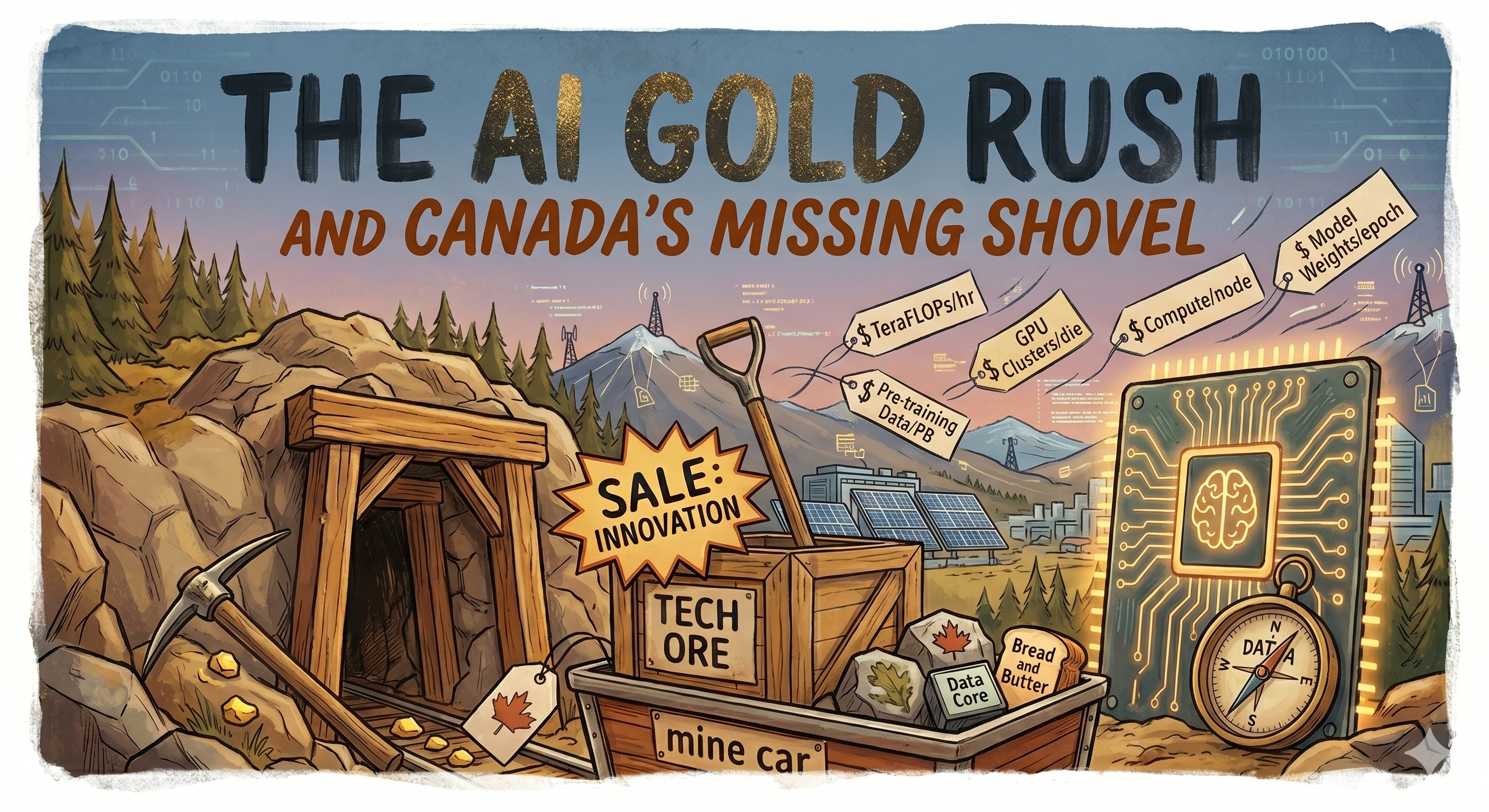
Canada's position in the global AI landscape is genuinely paradoxical. We are simultaneously one of the most important countries in AI and one of the least commercially successful. We train the researchers, publish the papers, and win the awards. Then we watch the economic value migrate to jurisdictions that understood something we apparently didn't: in a gold rush, the money isn't in finding the gold. It's in selling the shovels. And building the mining town. And owning the railroad that ships the gold to market.
We found the gold. We taught the world where to dig. And now we're standing in the claim, watching other countries build the infrastructure around us, wondering why we didn't think to open a general store.
The Pan-Canadian AI Strategy is due for its next phase of renewal. The SR&ED program is under review. The sovereign compute fund is being allocated. These are real decision points. The choices made in the next 18 months will determine whether Canada remains a talent factory for other nations' AI industries or finally builds the commercial ecosystem to match its research prowess.
The talent is ours. The ideas are ours. The question is whether we're willing to do what it takes to keep the companies ours too. Because the rest of the world isn't going to wait around while we hold another round of consultations.
References
[1] CIFAR, "Pan-Canadian AI Talent Landscape Report," 2025.
[2] Statistics Canada, "International Mobility of Science and Technology Workers," Catalogue no. 11-626-X, 2024.
[3] Innovation Economy Council, "State of Canada's AI Ecosystem: Annual Report," 2025.
[4] Start-Up Nation Central, "AI Startup Ecosystem Report," 2025.
[5] Innovation, Science and Economic Development Canada (ISED), "Pan-Canadian Artificial Intelligence Strategy: Phase 2 Renewal," 2024.
[6] Brookfield Institute for Innovation + Entrepreneurship, "Levelling Up: Assessing Canada's AI Commercialization Gap," 2024.
[7] UK Department for Science, Innovation and Technology, "National AI Strategy: Two-Year Progress Review," 2025.
[8] Office of the Parliamentary Budget Officer, "SR&ED Tax Incentive Program: Utilization and Effectiveness Review," 2024.
[9] Government of Canada, Budget 2025, "Canada Strong: Investing in Growth, Chapter 4 — Digital Infrastructure and Artificial Intelligence."