Published on April 5, 2026
You know something's off when you walk out of a grocery store with two bags and a receipt that looks like a car payment. You didn't buy lobster. You didn't impulse-grab the imported cheese. You bought chicken, bread, milk, some vegetables, and a box of cereal. Somehow, that's $87.
This is the affordability conversation Canadians are actually having — not in economic journals, not in parliamentary committee rooms, but in parking lots and group chats. The Consumer Price Index says inflation has cooled down. Your wallet says otherwise. So who's right?
Both, technically. But the CPI story and the lived-experience story are two very different narratives, and understanding the gap between them matters more than ever.
The CPI Problem: Measuring Temperature with a Broken Thermometer
The Consumer Price Index tracks the average price change across a basket of about 700 goods and services [1]. It's a useful tool. It's also a deeply misleading one if you use it as a stand-in for "how expensive life feels."
The biggest distortion comes from shelter. Statistics Canada weights shelter costs at roughly 30% of the CPI basket [1]. That made sense decades ago when housing consumed about a third of household income. But for renters in major Canadian cities, shelter now eats 50% or more of gross income [2]. If you're a renter in Toronto or Vancouver, the CPI is measuring your cost of living with a formula that dramatically underweights the single largest line item on your budget.
It gets weirder. The CPI measures mortgage interest costs, not home prices themselves. So when a house goes from $600,000 to $900,000, that price increase doesn't directly show up in inflation data. What shows up is the change in carrying costs — which, during periods of low interest rates, can actually fall even while prices skyrocket.
The Bank of Canada uses CPI-trim and CPI-median to strip out volatile components and get a "core" inflation read. These are useful for monetary policy. They are useless for telling you why your grocery bill doubled.
Grocery Inflation: Death by a Thousand Price Tags
Dalhousie University's Agri-Food Analytics Lab publishes Canada's Food Price Report annually, and their 2025 edition projected food cost increases of 3% to 5% for the year [3]. That sounds manageable until you stack it on top of the previous five years.
Consider what's happened to staple prices since 2020. A kilogram of chicken breast that cost around $13 in 2020 now runs closer to $18 in most major grocery chains [4]. A loaf of bread has gone from roughly $2.80 to $3.80. A four-litre bag of milk — that peculiarly Canadian institution — has climbed from about $4.50 to over $6.50 in Ontario [4].
None of these increases feel dramatic in isolation. But they're cumulative. Statistics Canada's food component index shows grocery prices rose approximately 21% between January 2020 and late 2025 [1]. Wages over the same period? Up about 15% on average [5]. That's a gap that compounds every single month.
And the price tag doesn't tell the whole story, because of a phenomenon every Canadian shopper has noticed even if they don't know the term for it.
Shrinkflation: The Quiet Heist
Shrinkflation is when manufacturers reduce the size of a product while keeping the price the same, or sometimes even raising it. It's technically not inflation — you're still paying $5.49 for a box of crackers. You're just getting 15% fewer crackers.
Canadian examples are everywhere once you start looking. Tropicana orange juice containers shrank from 2.63 litres to 2.21 litres. Packages of Häagen-Dazs dropped from 500ml to 450ml. Frito-Lay chip bags that used to be 280g now sit at 235g [6]. The unit prices are climbing even when shelf prices hold steady.
Statistics Canada does attempt to adjust for quantity changes in its CPI calculations, but the adjustments don't always capture the full picture, especially for products that change size gradually over multiple quarters [1]. For consumers, the experience is a slow erosion of purchasing power that doesn't show up in headline numbers.
It's the economic equivalent of your sweater shrinking in the wash. Nobody did anything dramatic. It just... fits differently now.
Rent: The Regional Horror Show
If grocery inflation is death by a thousand cuts, rent is more like a single, clean blow to the savings account.
The Canada Mortgage and Housing Corporation's 2024 Rental Market Report documented the national picture: average rents for purpose-built apartments rose 8% year-over-year, the fastest pace in decades [2]. But national averages obscure the real variation between cities.
In Vancouver, the average two-bedroom purpose-built rental hit $2,181 per month in CMHC's most recent survey. Toronto was close behind at $1,957. Calgary, once considered affordable by major-city standards, saw rents surge to $1,695 — a jump of over 14% in a single year as population growth outpaced housing supply [2].
Halifax tells a particularly striking story. A decade ago, it was the kind of city where a one-bedroom rented for $800 and people moved there specifically because it was cheap. By 2024, the average one-bedroom had hit $1,449 [2]. Rents in Halifax roughly doubled in five years, driven by immigration, interprovincial migration, and a construction sector that couldn't keep pace.
Montreal remains the relative bargain among major cities, with average two-bedrooms around $1,100, but even there, rents have been climbing 5-7% annually [2].
For anyone who signed a lease in 2019 and has since moved, the sticker shock isn't gradual. It's immediate and visceral. You're not paying 3% more. You're paying 40-60% more for a comparable unit.
Gas and Getting Around: The Hidden Costs
Gasoline gets all the political attention because the price is literally displayed on giant signs at every intersection. But fuel is only part of the transportation cost story.
Gas prices in Canada have been volatile — bouncing between $1.30 and $1.80 per litre across most of the country over the past two years, depending on global oil prices, refinery margins, and the usual regional taxes [7]. The carbon levy adds about 17 cents per litre at current rates. For someone driving 20,000 kilometres a year in a vehicle that gets 10 litres per 100km, fuel costs run roughly $3,000 to $3,600 annually.
But car insurance is where the real regional absurdity shows up. Ontario drivers pay the highest auto insurance premiums in the country — an average of roughly $1,700 to $2,000 annually, compared to about $1,300 in Alberta and under $1,000 in Quebec, which uses a public insurance model [8]. If you're in the GTA, you might be paying $2,500 or more, which means your insurance costs more than your gas.
Transit isn't cheap either. A monthly Metropass in Toronto runs $156. In Vancouver, a three-zone monthly pass is $189.45. These are significant costs for workers who are already stretched thin by rent and groceries.
Add it up — fuel, insurance, maintenance, or alternatively transit passes — and transportation consumes 15-20% of a typical household budget [1]. That's real money that doesn't get the same political attention as housing.
Wages vs. Costs: The Race Nobody's Winning
So are Canadians actually falling behind? The data says yes, but with caveats.
Statistics Canada reports that average hourly wages grew approximately 4-5% year-over-year through much of 2024 and 2025 [5]. That sounds decent until you realize it followed years of wage growth that lagged inflation. Between 2020 and 2025, cumulative wage growth was around 15-18% for the median worker [5]. Cumulative CPI inflation over the same period was roughly 17-20% [1].
That's close to a wash on paper. But remember the CPI problem: it underweights the categories that hit hardest. If your rent went up 50% and your groceries went up 21%, a 17% raise doesn't come close to covering the gap.
The squeeze is worst for younger Canadians and lower-income households. Workers under 35 spend a higher share of income on rent and food than older Canadians who bought homes when prices were sane [9]. The Bank of Canada's own surveys show that Canadians consistently perceive inflation as higher than the official rate — not because they're bad at math, but because the official rate doesn't reflect their actual spending patterns [10].
What $100K Buys You: A Tale of Three Cities
Regional variation in Canada is enormous, and it fundamentally shapes what "middle class" means depending on your postal code.
A $100,000 salary in Winnipeg puts you solidly in comfortable territory. Average rent for a two-bedroom is around $1,300 per month. Groceries track close to the national average. You can own a home on that income without requiring a co-signer, a second job, or an inheritance [2].
That same $100,000 in Halifax gets you a decent life, but it's tighter than it was five years ago. Rent has climbed sharply, and while you might still be able to buy a starter home, you're looking at $400,000-plus for anything that isn't a fixer-upper an hour outside the city [11].
In Toronto, $100,000 is a struggle if you're renting. After taxes, you're taking home roughly $6,200 per month. A one-bedroom apartment in the city averages $2,200-plus [2]. Groceries, transit, phone, insurance — you're looking at another $1,500-$2,000 in fixed costs. That leaves maybe $2,000-$2,500 for everything else: savings, debt payments, clothing, any kind of social life. Homeownership on a single $100,000 income in the GTA is essentially a fantasy without significant family wealth [11].
Same country. Same salary. Wildly different realities. And yet federal policy tends to treat "the Canadian cost of living" as a single, national experience.
Policy Levers: What Could Actually Help?
Governments aren't powerless, but the most effective levers are slower and less politically exciting than the ones that get promised during campaigns.
On housing supply, the federal Housing Accelerator Fund has pushed municipalities to speed up zoning and permitting [12]. It's directionally correct, but building takes years, and Canada needs an estimated 3.5 million additional homes by 2030 to restore affordability, according to CMHC's own projections [12]. That's a pace of construction this country has never sustained.
On grocery prices, the federal government's stabilization efforts — including the Grocery Code of Conduct — aim to improve competition and transparency in a market dominated by three major chains (Loblaw, Metro, and Empire) that collectively control roughly 40% of the market [3]. Whether voluntary codes of conduct meaningfully affect prices remains an open question.
Provincial rent control policies vary wildly. Ontario caps annual increases for existing tenants at a guideline tied to CPI (2.5% for 2025), but exempts units built after November 2018 from any caps [13]. British Columbia has a similar structure. Alberta has no rent control at all. The policy patchwork means tenant protections depend entirely on where you live and when your building was constructed.
On the wage side, minimum wage increases have been meaningful — Ontario's jump to $17.20 and BC's to $17.40 have helped the lowest earners [14]. But for the broad middle class earning $50,000 to $80,000, there's no policy lever that directly addresses the squeeze. Tax credits and benefit adjustments help at the margins, but they don't change the fundamental math of costs growing faster than paycheques.
The Bottom Line
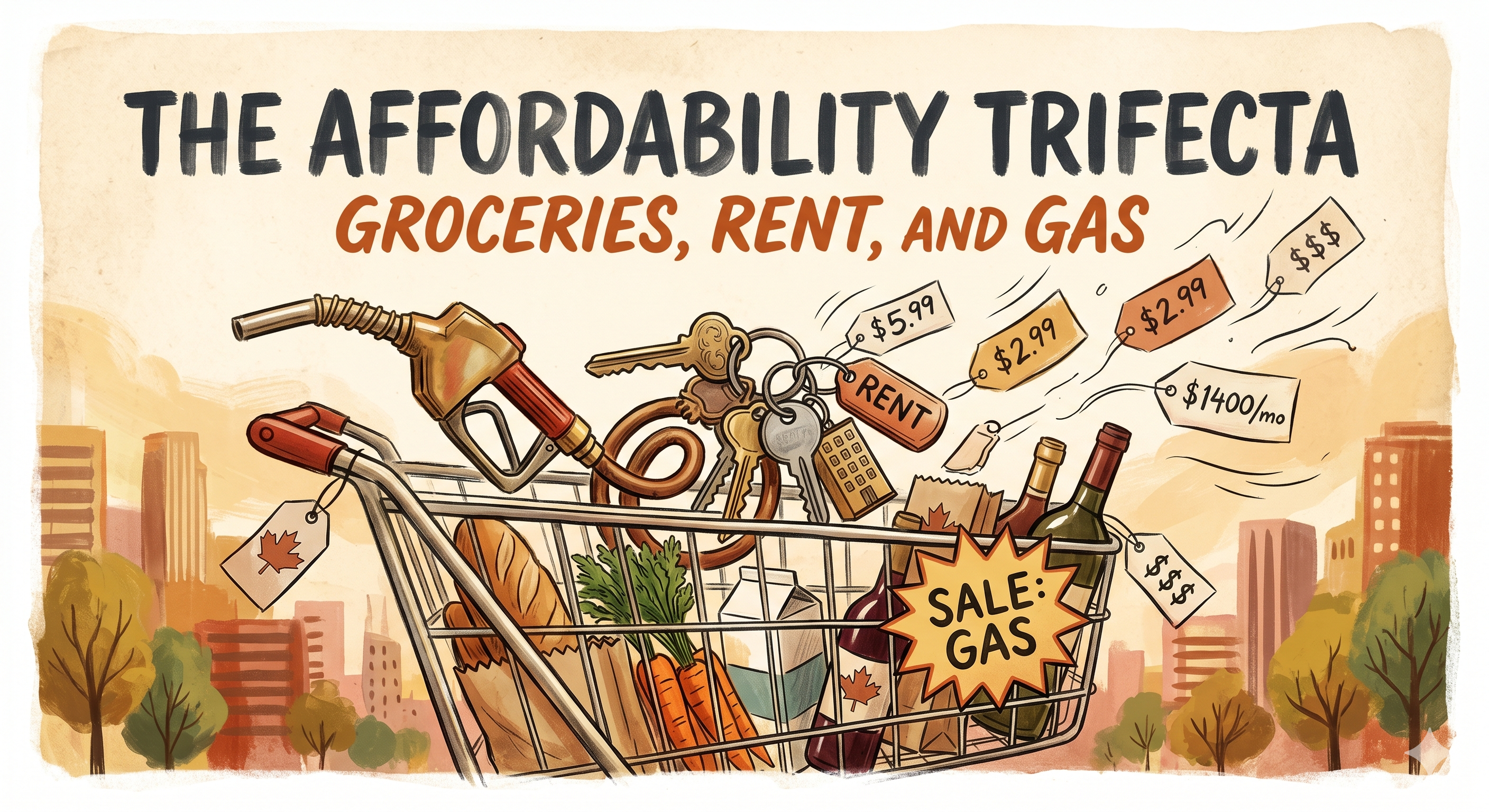
The affordability crisis in Canada isn't one problem. It's three problems — groceries, rent, and transportation — stacked on top of each other and reinforced by a measurement system that makes the official numbers look better than the lived experience.
CPI says inflation is under control. Your budget says otherwise. You're not imagining it. The gap between the statistical story and the kitchen-table reality is real, measurable, and growing.
No single policy will fix this. Housing supply takes years. Grocery competition takes political will. Wage growth takes productivity gains that Canada has struggled to achieve for a decade. But understanding where your money actually goes — and why the official numbers don't match what you feel — is the first step toward demanding better answers from the people who set the rules.
In the meantime, you'll keep buying the smaller cereal box at the same price, scanning the flyer apps before grocery runs, and doing the mental math on whether it's cheaper to drive or take the TTC. Because that's the Canadian affordability trifecta: not a crisis anyone chose, but one everyone's learning to navigate.
References
[1] Statistics Canada. "Consumer Price Index, monthly, not seasonally adjusted." Table 18-10-0004-01. 2025.
[2] Canada Mortgage and Housing Corporation. "Rental Market Report." January 2024.
[3] Dalhousie University Agri-Food Analytics Lab. "Canada's Food Price Report 2025." December 2024.
[4] Statistics Canada. "Monthly average retail prices for food and other selected products." Table 18-10-0002-01. 2025.
[5] Statistics Canada. "Labour Force Survey, wages and salaries." Table 14-10-0063-01. 2025.
[6] Canadian Broadcasting Corporation. "Shrinkflation in Canada: Products that have gotten smaller." 2024.
[7] Natural Resources Canada. "Fuel prices across Canada." 2025.
[8] Insurance Bureau of Canada. "Auto insurance trends in Canada." 2024.
[9] Statistics Canada. "Survey of Household Spending." Table 11-10-0222-01. 2024.
[10] Bank of Canada. "Canadian Survey of Consumer Expectations." Q4 2024.
[11] Canadian Real Estate Association. "National statistics and MLS HPI." 2025.
[12] Canada Mortgage and Housing Corporation. "Housing Supply Report." 2024.
[13] Ontario Landlord and Tenant Board. "2025 Rent Increase Guideline." 2024.
[14] Government of Ontario / Government of British Columbia. "Minimum wage announcements." 2024-2025.